The Homeostatic Economy
The Echo Collective's self-regulating economic system.
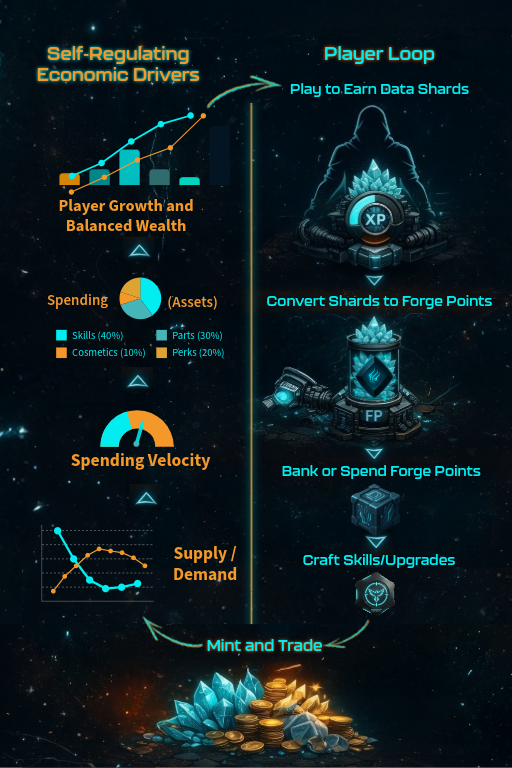
Why This Economy Exists
One of the Reticle Cold War's key innovations is the Homeostatic Game Economy, a self-regulating system inspired by natural predator-prey dynamics.
Unlike traditional game economies that rely on fixed sinks and faucets or player-driven markets alone, this system uses autonomous agent populations, deep analytics (predictive and tracking) and behavioral nudges to maintain economic equilibrium while combatting common economic pitfalls such as hyperinflation and value extraction.
Economic management goals are:
- Sustainability
- Flexibility and resiliance
- Value preservation
- Fair resource distribution
Core Economic Resources
| Resource | How You Get It | What It's For |
|---|---|---|
| Data Shards | Automatically awarded based on player activity and level | Load into Forge Engine to produce Forge Points |
| Forge Points (FP) | Generated by your Forge Engine | Skills, crafting, faction advancement |
| Memory Fragments (💠 MF) | Earned through Great Sync competition based on contribution and machine placement | Essential operating currency: Forge Engine operations (shard loading tax, engine part costs), component crafting, allegiance switching, consumables, skill redistribution, Attractor Module feeding. See Memory Fragments. |
The Natural System Model
The economy mirrors natural regulatory systems:
Stellar Equilibrium: Stars balance gravity (inward) against nuclear fusion (outward) for billions of years.
Predator-Prey Dynamics: Prey abundance grows predator populations, which reduce prey, which reduces predators—oscillating around stable averages.
Physiological Homeostasis: Your body maintains blood sugar through constant feedback loops, adjusting automatically.
The Echo Collective economy applies these same principles.
How It Works
Step 1: Earn Data Shards
 Data Shards—the raw currency of the Echo Collective economy
Data shard delivery is based on the level of player activity:
- Completing scenarios and missions
- Solving intelligence challenges
- Combat victories
- Mini-game performance
This prevents delivering shards to players that are not active.
Critical: Data Shards decay over time if not used. The system rewards active participation.
Step 2: Load Your Forge Engine
Your Forge Engine converts Shards to Forge Points:
- Load Data Shards into your Engine (💠 MF tax applies: 0.5% of shards loaded, max 8 MF per load)
- Engine attracts Producer agents that feed on Shards
- Producers generate Forge Points through their activities
- FP accumulates in your balance
Note: Shard loading and engine part application require a Memory Sink (unlocked through early missions) and cost Memory Fragments. Without MF, these operations are blocked. See Memory Fragments.
 Producer agents consume Data Shards and generate Forge Points
Step 3: The Predator-Prey Balance
Here's where natural regulation occurs:
- Predator agents hunt Producers, consuming them before they complete FP generation
- When FP supply is high compared to economic needs → More Predators spawn → Fewer Producers survive → FP generation decreases
- When FP supply is low compared to economic needs → Predator population drops → More Producers survive → FP generation increases
 Predator agents hunt Producers to regulate Forge Point supply
Result: FP supply automatically oscillates around healthy levels without central control.
Your Forge Engine
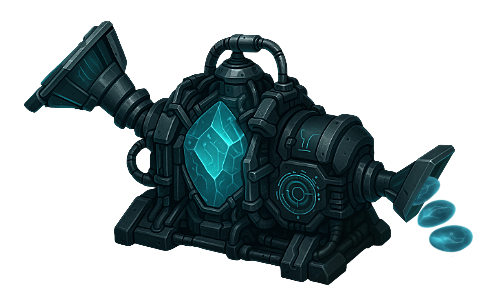 Your Forge Engine processing Data Shards
Your personal connection to the ecosystem.
Engine Performance Factors:
| Factor | Impact |
|---|---|
| Engine Condition | Degrades over time; affects efficiency |
| Shard Loading | Empty engines attract no Producers |
| Ecosystem Health | Population-wide balance affects your Forge Point generation rates |
| Maintenance | Engine Parts restore/improve efficiency (increase the machine's ability to generate Forge Points) |
Maintenance Tiers:
- Basic Engine Parts: 10% efficiency increase
- Uncommon Parts: 15% efficiency increase
- Rare Parts: 20% efficiency increase
- Legendary Parts: 30% efficiency increase
Cost: Each engine part application costs 1 💠 MF. Maintaining your engine requires a steady fragment supply.
Adaptive Intelligence
An AI economic manager monitors broader patterns every 8-12 hours:
- Tracks FP generation vs. consumption
- Detects resource oversupply
- Learns from historical cycles
- Adjusts ecosystem parameters to maintain health
The AI guides the system toward equilibrium by examining current, historical and predicted economic patterns.
Strategic Implications
Resource Velocity Matters
The system rewards operatives who actively circulate resources:
- Earn Shards → Load Engine → Spend FP → Develop skills → Earn more Shards
Hoarding creates stagnation; participation creates prosperity.
Collective Health Benefits Everyone
When the ecosystem maintains healthy balance, all operatives benefit. Mechanisms like FP degradation (negative interest on stored balances) encourages spending.
Strategic Timing
Understanding population cycles allows optimization:
- High Producer populations = better FP generation
- High Predator periods = conserve resources until conditions improve
Maintenance Compounds Returns
Operatives investing in regular Engine maintenance accumulate substantially more FP over time than those who neglect upkeep.
Anti-Exploitation Design
The system resists common economic exploits:
| Exploit Attempt | System Response |
|---|---|
| Automation/botting | Requires genuine skill advancement and strategic gameplay |
| Market flooding | Producer-Predator dynamics throttle oversupply |
| Resource monopolization | Individual engines have natural limits |
| Pay-to-win | FP generation requires active participation |
Your First Week: Practical Defaults
New operatives often ask: "What's normal?" Here's what early economy looks like:
A Typical Day
DAILY ECONOMY EXAMPLE (Week 1 Operative)
════════════════════════════════════════
Load Forge Engine             → ~50 FP generated over day
                               (a sample FP generation rate; this fluctuates)

Evening spend plan (sample spending amounts):
  Skill upgrade               → -25 FP
  Engine maintenance          → -10 FP
  Save for vault              → -15 FP
════════════════════════════════════════
What Decay Means in Practice
Data Shards decay at approximately 5% per cycle (which occur every 3 hours) when unloaded. This means:
- 100 Shards today → ~95 Shards in 6 hours if unused
- Load daily to minimize losses
- Don't hoard Shards "for later"—they'll be worth less
FP decay (during oversupply periods) is gentler: 2% daily on liquid (unvaulted) balances.
Vaulted FP does not decay. This is why vaults exist.
Practical Tips
Daily habits:
- Check Forge Engine status
- Load Data Shards consistently (don't let them decay)
- Monitor your 💠 MF balance — you need fragments for shard loading and engine parts
- Participate in the Memory Machine to sustain your fragment supply
- Look for strategic opportunities to save FP in vaults
Resource allocation:
- Skill upgrades (permanent improvement)
- Item crafting (equipment, consumables)
- Engine maintenance (efficiency preservation)
- Faction advancement (relationship building)
Learn More
- Skills & Progression - How FP are required for skill, character and faction upgrades
- Memory Machine - The Great Sync competition
- Equipment & Crafting - Crafting basics