Great Sync Cycles
The 96-hour rhythm that drives faction competition.
The Origin
Centuries ago, Technomage Master Kyrils Byndr summoned representatives from all four major factions to a remote base in the Unknown Regions. There, he provided each faction with blueprints for devices he called "Memory Machines"—though each faction received slightly different specifications.
His instructions were cryptic: "Build your machines, pit them against each other, grow them in power. There will be a time when the machine intelligence you call the Metric will become distracted. That will be your time, but nothing is given, only earned."
Within months, all four factions had constructed their machines and begun the competition Byndr requested. What started as cautious experimentation escalated into an all-out technological arms race.
The 96-Hour Cycle
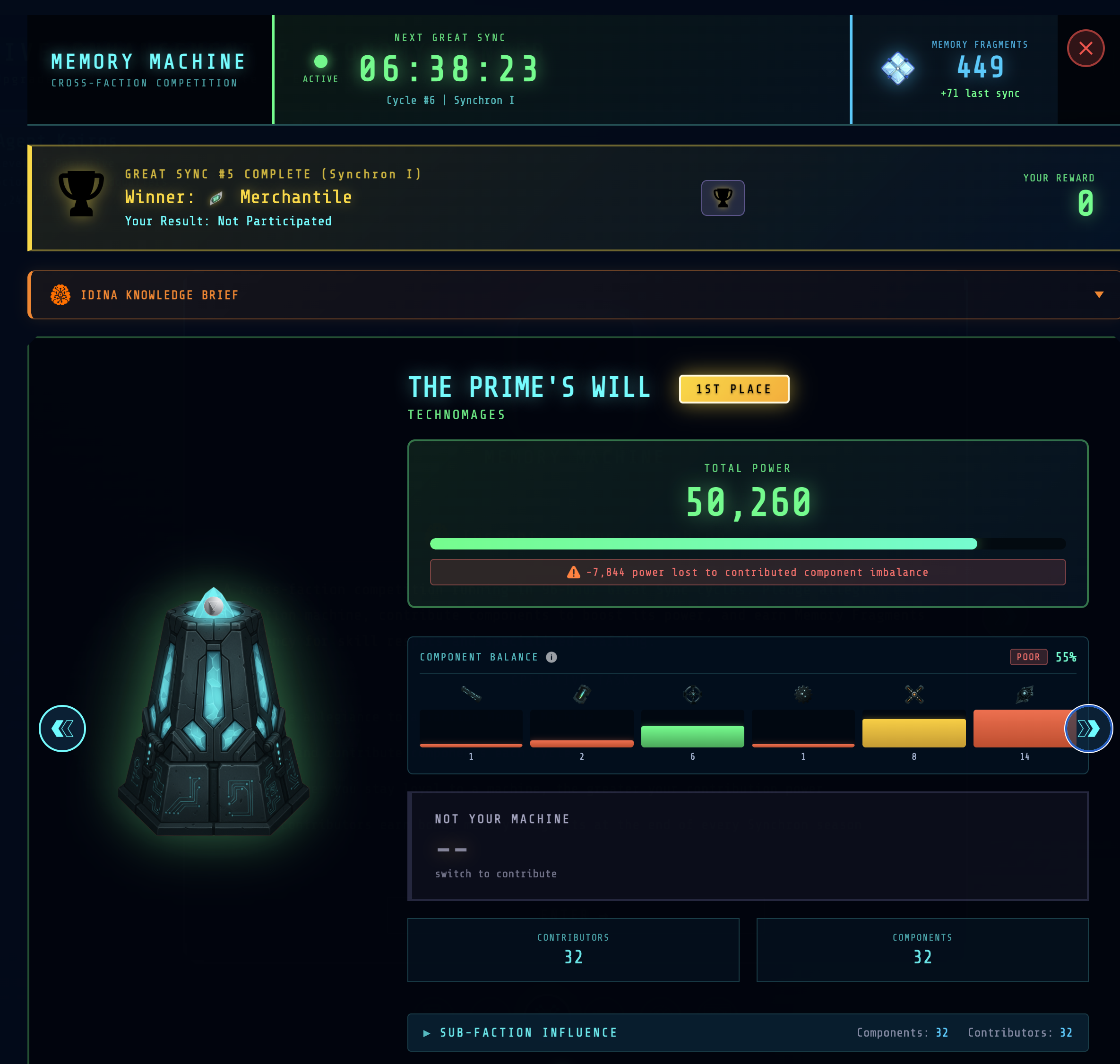
Every 96 hours, all four Memory Machines simultaneously link in the Great Sync—a mysterious synchronization where machines compete based on accumulated contributions.
Cycle Timeline
| Phase | Hours | What Happens |
|---|---|---|
| Contribution Period | 0-95 | Players and sub-faction operatives craft and contribute components |
| Deadline | 95 | Final cutoff for submissions (1 hour before next Great Sync cycle) |
| Calculation | 95-96 | System processes contributions, calculates rankings during a one hour period |
| New Cycle | 96 | Results recorded and displayed, rewards distributed, fresh cycle begins |
Live Rankings & NPC Contribution Batches
Rankings update continuously as contributions accumulate—not just at cycle end.
Sub-faction operatives contribute in 12 batches spread across the 95-hour window (~8 hours apart). After each batch, machine standings can shift significantly. This creates a dynamic competition where:
- Your comeback bonus is calculated at the moment you contribute based on current standings
- A machine trailing early may surge after NPC batches
- Strategic timing matters: contribute when your machine's ranking gives you the best multiplier
Synchron Seasons
Eight consecutive Great Syncs form a Synchron season (~32 days). This longer cycle determines overall faction dominance and distributes substantial bonus rewards.
Determining the Champion
The Synchron Champion is the faction whose machine wins the most individual Great Syncs during the season. With 8 syncs per season:
- 4+ wins guarantees championship
- Ties are broken by total cumulative power across all 8 syncs
- A dominant faction can sweep the season; an underdog can surge late
Season-End Rewards
When a Synchron season concludes, rewards are distributed in two tiers:
Faction Victory Bonus
All contributors to the winning faction's machine receive a Faction Victory Bonus—regardless of individual contribution ranking. This bonus equals approximately one week's worth of Memory Fragment spending, calculated from average player activity.
| Reward Type | Recipients | Amount |
|---|---|---|
| Faction Victory | All winning faction contributors | ~1 week fragment value |
Top Contributor Consolation
The top 25 individual contributors who did NOT contribute to the winning faction receive consolation rewards:
| Tier | Ranks | Multiplier | Description |
|---|---|---|---|
| Elite | 1-10 | 1.0× | Full consolation bonus |
| Runner-up | 11-25 | 0.5× | Half consolation bonus |
Important: No double-dipping. If you contributed to the winning faction, you receive the Faction Victory Bonus—you cannot also claim a top contributor consolation slot.
What Resets, What Persists
| Element | Season End Behavior |
|---|---|
| Machine Power | Resets to zero |
| Faction Rankings | Reset for new season |
| Loyalty Tier | Preserved (continues accumulating) |
| Contribution History | Archived for records |
Your loyalty tier carries across seasons, so Commander-tier players maintain their 1.30× bonus into the next Synchron.
Strategic Implications
- Winning faction focus: If your faction is dominant, stay loyal—the Faction Victory Bonus rewards all contributors
- Underdog strategy: If your faction trails, strong individual performance can still earn Elite consolation
- Late-season switching: Risky—you might lose both the Victory Bonus AND your consolation ranking
- Loyalty preservation: Since loyalty persists across seasons, Commander-tier players benefit from staying put
How Competition Works
You're Not Alone: Sub-Faction Operatives
A critical dynamic: you compete alongside AI-controlled sub-faction operatives—not just other players.
Each faction's Memory Machine receives contributions from:
- Players aligned with that faction
- Sub-faction operatives (NPCs) commanded by AI agents that make strategic decisions
This isn't simple randomness. Each Great Sync features sophisticated NPC behavior driven by AI-powered Subfaction Commanders—intelligent agents that analyze game state and issue strategic directives to their operative networks.
The Subfaction Commander System
Behind the scenes, six subfactions operate according to fixed behavioral patterns:
| Subfaction | Alliance | Typical Behavior |
|---|---|---|
| Whisperers | Prospectors | Intelligence-focused, adaptive strategies |
| Sercantos | Prospectors | Opportunistic, exploits ranking shifts |
| Trusonaries | Cypherians | Tech-driven, consistent contributions |
| Neo Yakuza | Scions of Ogo | Aggressive commitment, coalition-builder |
| Savant Acolytes | Centopoly | Analytical, responds to data patterns |
| Robed Pratorians | Mercantile Alliance | Cautious, preserves resources for key moments |
At the start of each Great Sync, each subfaction's AI commander receives a briefing on current conditions:
- Machine faction rankings and power gaps
- Player alliance distribution
- Historical sync outcomes
- Intelligence about other subfaction positions
Based on this intelligence, commanders generate strategic directives that determine:
- Target Allocation: Which machine(s) their operatives will support
- Commitment Level: How aggressively operatives will follow orders (some commanders allow more independent action)
- Coalition Preferences: Which other subfactions to cooperate with or oppose
- Adaptation Triggers: Conditions that warrant mid-sync strategy changes
Strategic Behaviors to Watch For
Frontrunner Suppression: Subfaction commanders often coordinate to prevent any single machine from running away with victory. If the Scions machine takes an early commanding lead, expect multiple subfactions to redirect resources toward competing machines. The commanders understand that a predictable outcome serves no one's long-term interests.

Coalition Formation: Commanders make deals. The Whisperers and Neo Yakuza might agree to jointly support the Technomages machine this sync, while the Robed Pratorians and Savant Acolytes form a counter-coalition. These alliances can be inferred from sub-faction contribution patterns and the Strategic Focus meter in the interface.
Mid-Sync Pivots: Approximately halfway through the contribution window, commanders reassess their strategies. If their target machine has collapsed in the rankings, or if an unexpected coalition has formed against them, they may issue new directives. Watch for sudden shifts in NPC contribution patterns around hours 40-50.
Commitment Variance: Not all operatives follow orders perfectly. A commander with "aggressive" commitment sees 90-100% of operatives execute the strategy. A "conservative" commander might see only 60-70% compliance, with the remainder making independent decisions based on personality:
| Personality | Behavior |
|---|---|
| Loyalist | Supports their subfaction's traditional machine |
| Opportunist | Chases the best comeback bonus |
| Strategist | Evaluates expected value across all options |
This means even within a coordinated subfaction, individual operatives may take surprising actions.
Reading the Meta
Specific NPC strategies are not disclosed. Players must observe and deduce:
- Watch contribution timing: When do large NPC batches hit each machine? Do they cluster around certain hours?
- Track ranking shifts: A machine that suddenly gains 20% power between batches indicates coordinated subfaction support
- Monitor patterns across syncs: Does a particular subfaction consistently target frontrunners? Do certain alliances recur?
- Note mid-sync pivots: Dramatic strategy changes around hour 45 suggest triggered adaptations
Over time, experienced players develop intuitions about subfaction tendencies. The Neo Yakuza might favor aggressive early commitments. The Sercantos might wait to see which machine is trailing before piling in for comeback bonuses. The Robed Pratorians might consistently hedge across multiple machines.
This emergent meta is intentional. Part of mastering the Great Sync is learning to read—and anticipate—the AI commanders' strategic decisions. Their logic is sophisticated but not random. With careful observation, you can predict where the next wave of NPC contributions will land.
Why This Matters
The AI commander system creates strategic depth:
- Unpredictability without randomness: Commanders respond to real game conditions
- Player actions ripple outward: Your contribution choices affect machine rankings, which affects commander decisions, which affects the entire competitive landscape
- No solved game: Since commanders adapt to player behavior and each other, the optimal strategy evolves continuously
- Intelligence warfare: Information about NPC behavior patterns becomes valuable—trading insights about subfaction tendencies is itself a form of gameplay
You're competing in an ecosystem where AI agents make strategic decisions about resource allocation, form temporary alliances, and adapt to changing conditions—just like you do.
Component Contributions
Players craft six component types, each drawing power from different skills:
| Component | Base Power | Skills Required |
|---|---|---|
| Machine Conduits | 100 | Pattern Recognition, Cybernetics, Information Gathering, Alliance Building, Tactical Planning |
| Machine Fuel | 150 | Bridge Tech, Reticle Navigation |
| Machine Cores | 200 | All 6 Intelligence skills |
| Contest Algorithms | 250 | Combat + Tech skills (6 total) |
| Contest Negotiation | 250 | Diplomacy skills (4 total) |
| Faction Interaction | 250 | Social skills (3 total) |
Grade multipliers scale exponentially: Grade I (3×), Grade II (6×), Grade III (8×), Grade IV (10×), Grade V (16×).
Power Score Calculation
Your contribution power is calculated as:
Base Power × Grade Multiplier × (1 + Skill Bonus) × Loyalty × Comeback × Synergy
Multipliers that affect your power:
| Bonus Type | Range | How It Works |
|---|---|---|
| Skill Bonus | 0-10% | Average of relevant skills |
| Loyalty Tier | 1.0×-1.30× | Increases with time at same faction |
| Comeback Bonus | 0.90×-1.30× | Higher for trailing machines |
| Faction Alignment | 1.02×-1.10× | If your character faction matches machine |
| Component Synergy | 0.70×-1.00× | Balanced contributions across all types |
Loyalty System
Sustained allegiance to one machine earns increasing bonuses:
| Tier | Duration | Bonus | Notes |
|---|---|---|---|
| Recruit | 0-13 days | 1.0× | Starting tier |
| Operative | 14-41 days | 1.05× | 2 protected switches (tier preserved) |
| Agent | 42-83 days | 1.15× | Significant bonus |
| Commander | 84+ days | 1.30× | Maximum loyalty reward |
Switching factions resets your loyalty tier—but sometimes the comeback bonus makes it worthwhile.
Comeback Mechanics
Trailing machines receive contribution bonuses to keep competition dynamic.
Critical: The comeback multiplier is applied at the moment you contribute, based on current standings—not locked at cycle start. If your machine is 4th when you contribute, you get the 1.30× bonus even if it finishes 1st.
| Machine Rank | Comeback Multiplier |
|---|---|
| 1st place | 0.90× (leader penalty) |
| 2nd place | 1.00× (neutral) |
| 3rd place | 1.15× (comeback boost) |
| 4th place | 1.30× (underdog advantage) |
This creates strategic tension: Do you stay loyal to build your tier, or switch to a trailing machine for the comeback bonus? And when do you contribute—before or after the next NPC batch?
Rewards
Memory Fragment Distribution
After each Great Sync, contributors receive Memory Fragments. The total reward pool is derived from the machine's spending capability, then distributed across four components:
| Component | Description |
|---|---|
| Base Participation | Flat amount for all contributors |
| Ranking Bonus | Percentage of target based on machine finishing position (1st > 2nd > 3rd > 4th) |
| Comeback Bonus | Extra percentage for machines that improved rank since previous sync |
| Contribution Bonus | Scales with your share of the machine's total contribution power |
Diversity Penalty on Rewards
The contribution bonus is further modified by a diversity factor based on how balanced your contributions are across the six component types. This is separate from (and stacks with) the synergy penalty applied at contribution time.
Contribution Bonus = Raw Contribution Bonus × Diversity Factor
| Balance Score | Diversity Factor | Effect |
|---|---|---|
| 100% (perfect balance) | 1.00× | Full contribution bonus |
| 75% | ~0.81× | Mild penalty |
| 50% | ~0.53× | Moderate penalty |
| 0% (single type only) | 0.30× | 70% of contribution bonus lost |
Graduated ramp: The diversity penalty scales with your total contribution count. Players with very few contributions (1-2) receive no diversity penalty. The penalty gradually increases as you contribute more, reaching full effect at 8+ contributions. This gives players time to learn the system while still incentivizing balance for serious contributors.
Dual penalty: An imbalanced contributor is penalized twice—once when contributing (reduced power via the synergy multiplier) and again at reward time (reduced MF via the diversity factor). This creates a strong incentive to diversify.
Marketplace incentive: Rather than contributing excess components of the same type, operatives are better served by selling surplus on the marketplace and purchasing types they're missing.
The Memory Machine modal displays a reward calculator showing your projected MF, the diversity factor impact, and which component types you're missing.
What Fragments Are For
Memory Fragments are an essential operating currency required for core gameplay operations:
- Forge Engine operations: Shard loading tax (0.5%, max 8 MF) and engine part loading (1 MF each)
- Component crafting: 10–20 MF per component (by grade)
- Allegiance switching: 50+ MF per switch (escalating monthly)
- Consumables: 10–20 MF per item
- Attractor Modules: 20/50/85 MF per sync cycle for Basic/Advanced/Elite
- Skill redistribution: Restructuring your capabilities
Without fragments, operatives lose access to basic economic functions. See Memory Fragments & Attractor Modules for full details.
Strategic Timing
Early cycle (hours 0-30): Contribute when you have fresh resources. Establishes baseline.
Mid-cycle (hours 30-60): Monitor rankings. Sub-faction operatives are making decisions based on current standings.
Late cycle (hours 60-95): Final push. Rankings can shift dramatically as deadline approaches.
After hour 95: No more contributions accepted. Wait for results.
The Mystery Persists
Despite centuries of Great Syncs, fundamental questions remain:
- What precisely happens when machines link consciousness?
- How do they warp probability to create Probability Matrix effects?
- Is there a hidden cost to Memory Machine technology?
- Why did Kyrils Byndr design 96-hour cycles specifically?
- Do the machines possess independent intelligence?
- What is the Metric's true relationship with these devices?
The Metric monitors Great Sync activities but remains silent. Some believe the accelerated development and redirection of inter-faction conflict serves its agenda. Others suspect it's simply waiting.
Kyrils Byndr provided the blueprints and disappeared into the Unknown Regions. His motivations remain completely unknown.
Learn More
- Memory Machine Overview — Competition structure
- Skills & Skill Checks — How skills affect contribution power
- The Homeostatic Economy — Earning Forge Points to craft components