Skills & Skill Checks
Your skills determine your operational capabilities—not as marginal advantages, but as fundamental capacity.
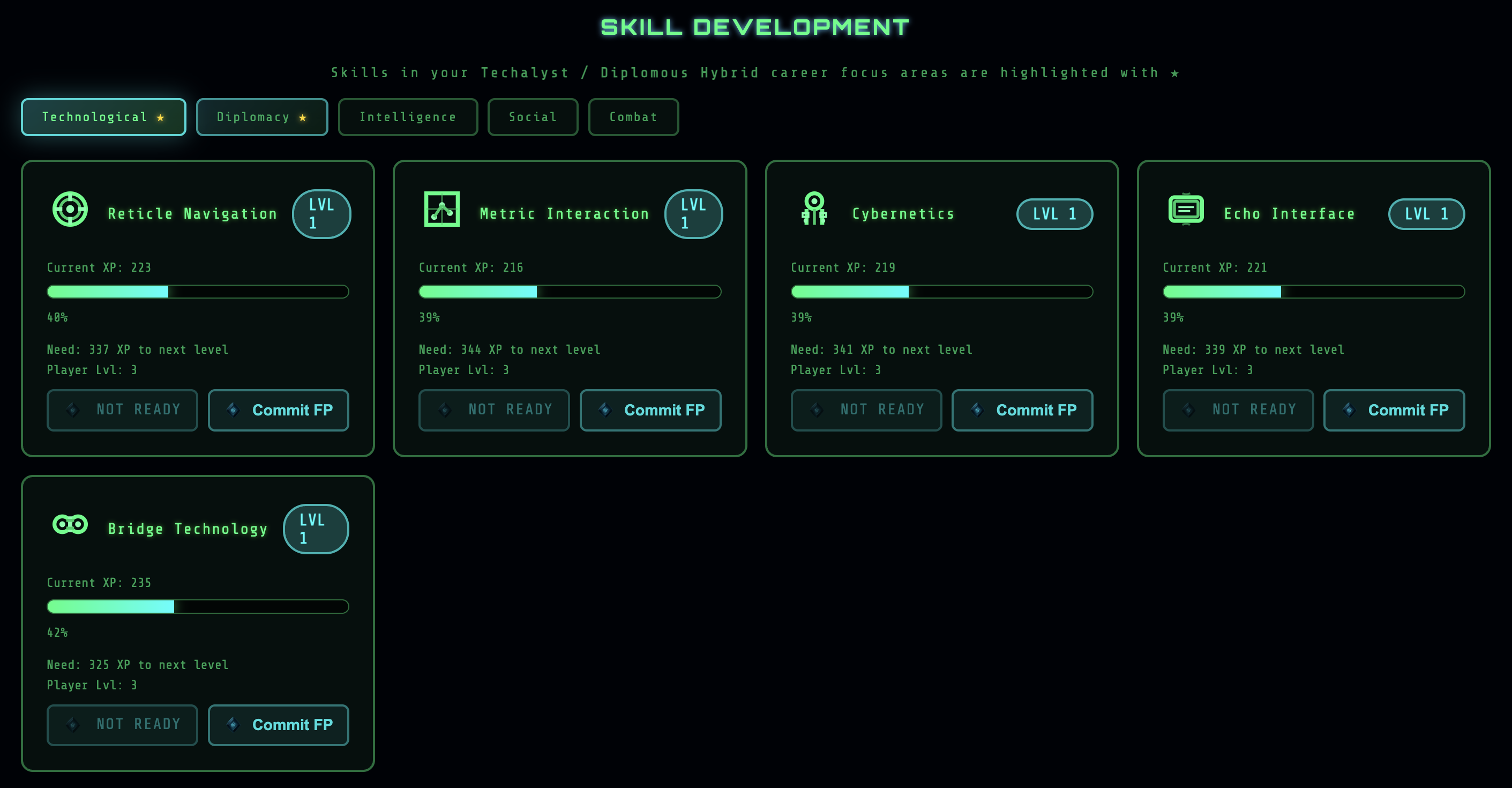
Why Skill Checks?
Unlike systems where abilities provide small bonuses, Reticle Cold War skill checks create meaningful uncertainty:
- Options gate by skill level — Low skills mean choices don't even appear
- Success is never guaranteed — Even experts can fail; novices always have hope
- Investment matters — Developed skills dramatically improve your odds
- Economy integration — Crafting failure rates create resource sinks
An operative with Analytical Thinking at level 3 faces vastly different odds than one at level 18. The system rewards skill investment while maintaining tension at every level.
The d20 System
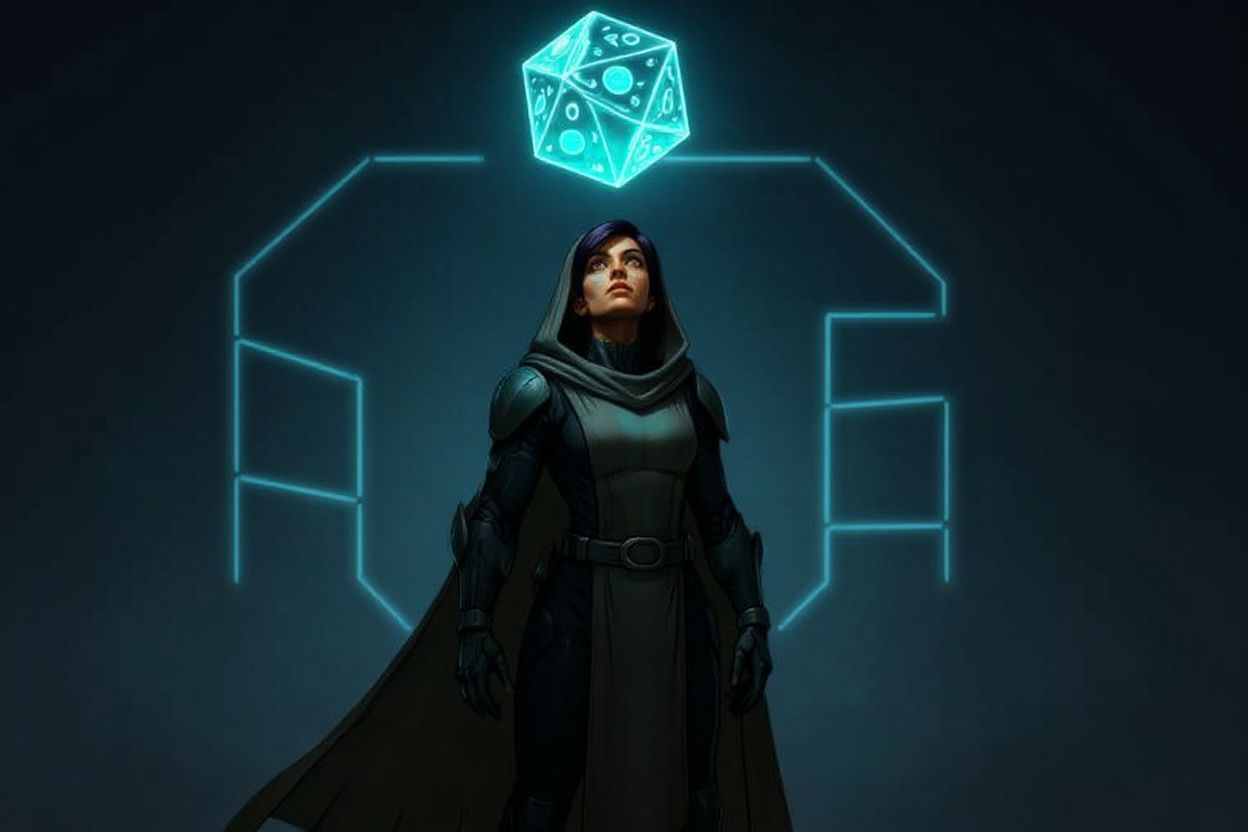
Reticle Cold War uses a d20 roll system inspired by Dungeons & Dragons 5th Edition:
d20 Roll + Skill Bonus vs. Difficulty Target
How It Works
- Roll a d20 — Random number from 1-20
- Add skill bonus — From skill levels, equipment, faction bonuses
- Compare to target — Meet or exceed = success
Difficulty Targets
| Difficulty | Target | Success Rate (No Bonus) | Success Rate (+13 Max) |
|---|---|---|---|
| Trivial | 10 | 55% | 95% |
| Easy | 14 | 35% | 90% |
| Medium | 18 | 15% | 70% |
| Hard | 21 | 0% | 50% |
| Extreme | 24 | 0% | 25% |
Critical Rolls
- Natural 1: Automatic failure (5% floor, regardless of bonuses)
- Natural 20: Automatic success (5% ceiling, regardless of difficulty)
Bounded Accuracy: Keeping the Game Challenging
A core D&D 5e design principle adopted here: skill bonuses cap at +13.
This prevents high-level players from trivializing content:
- Hard checks remain 50/50 even for max-level experts
- Extreme challenges (legendary crafts, elite missions) stay difficult at 25%
- Failure rates support a healthy crafting economy -- item production takes real effort, skill and good odds
- Every roll maintains meaningful tension
Without this cap, veteran players would auto-succeed on everything, eliminating challenge and breaking economic balance.
New Player Safety Net
Players at levels 1-5 receive a +1 competency floor bonus. After level 5, your invested skills carry full weight.
Types of Skill Checks
Mission Skill Checks
During scenarios, skill checks determine:
- Whether you succeed at objectives
- Which dialogue options appear
- Combat effectiveness and tactical options
Risk indicators show your odds before committing:
- GREEN: 70%+ success
- YELLOW: 40-70% success
- ORANGE: 20-40% success
- RED: <20% success
Crafting Skill Checks
Items impose hard skill gates plus success rolls:
| Item Tier | Difficulty | Success Rate |
|---|---|---|
| Common | Easy (DC 14) | 75-85% for skilled crafters |
| Uncommon | Medium (DC 18) | 55-70% at mid-level |
| Rare | Hard (DC 21) | 40-50% for advanced crafters |
| Legendary | Extreme (DC 24) | 25-35% even at max level |
Failed crafting consumes Forge Points—this is intentional for economy balance.
Memory Machine Contributions
During each 96-hour Great Sync cycle, you contribute components to your faction's Memory Machine. Your skill levels determine contribution power—how much each component strengthens your machine's competitive position.
| Component | Skills Used |
|---|---|
| Machine Conduits | Pattern Recognition, Cybernetics, Information Gathering, Alliance Building, Tactical Planning |
| Machine Fuel | Bridge Tech, Reticle Navigation |
| Machine Cores | Pattern Recognition, Memory Enhancement, Analytical Thinking, Information Gathering, Cosmos Lore, Metric Interaction |
| Contest Algorithms | Basic Combat, Advanced Combat, Tactical Planning, Specialized Weapons, Echo Interface, Cybernetics |
| Contest Negotiation | Negotiation, Political Strategy, Alliance Building, Crisis Management |
| Faction Interaction | Faction Relations, Cultural Adaptation, Network Building |
Power is calculated as the average of relevant skills (max +10% bonus) × grade multiplier.
Higher skills = more powerful contributions = better machine placement = greater individual rewards.
Faction Interactions
Diplomatic options require skill thresholds:
- High Social skills make negotiation easier
- Diplomacy expertise enables political maneuvering
- Technology proficiency enables technical solutions to challenges
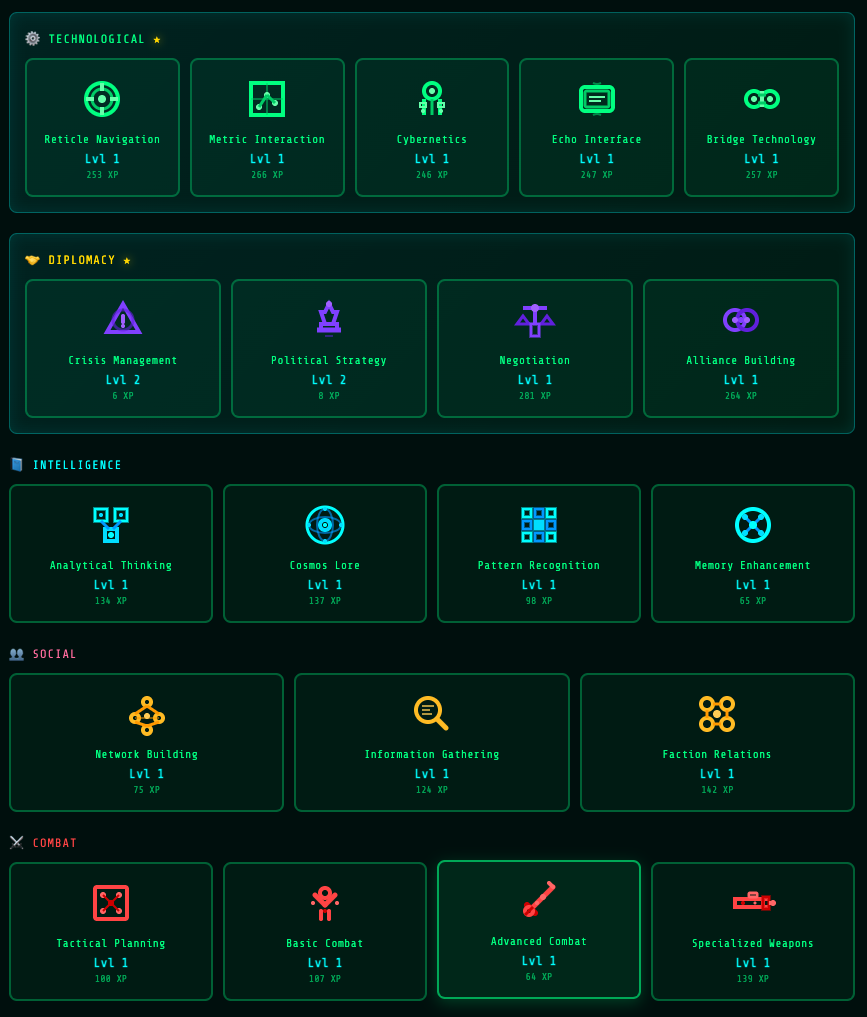
The 22 Skills
| Domain | Skills |
|---|---|
| Intelligence | Pattern Recognition, Memory Enhancement, Analytical Thinking, Information Gathering, Cosmos Lore, Metric Interaction |
| Technology | Bridge Tech, Reticle Navigation, Echo Interface, Cybernetics, Manufacturing |
| Combat | Basic Combat, Advanced Combat, Tactical Planning, Specialized Weapons |
| Social | Negotiation, Alliance Building, Network Building, Faction Relations, Cultural Adaptation |
| Diplomacy | Political Strategy, Crisis Management |
Skill Advancement
Progression requires both experience and investment:
Stage 1: Earn Skill XP
- Complete missions testing specific abilities
- Solve puzzles and challenges
- Training via mini-games (Confluence, TriDyak)
Different skills progress at different rates:
- Combat skills = slower (physical + tactical mastery)
- Social skills = faster (interaction-based)
- Technology skills = moderate
Stage 2: Spend Forge Points
Experience alone doesn't advance skills:
- Accumulated XP creates readiness for the next level
- Spending FP solidifies the capability
- Both are required—no shortcuts
Skill Bonuses
| Source | Bonus |
|---|---|
| Cosmetic Equipment | +1 to +5 per item (requires durability) |
| Faction Rank | +2% to +10% in faction-aligned skills |
| Echo Collective Rank | Up to +12% in Intelligence/Social/Diplomacy |
| Probability Matrix | +1 to +2 per check (consumes charges) |
Common Mistakes
| Mistake | Fix |
|---|---|
| Spreading too thin | Focus 2-3 skill areas via career selection |
| Ignoring risk warnings | Respect color indicators before committing |
| Hoarding FP | Invest consistently to advance skills |
| Neglecting equipment | Maintain gear to keep bonuses active |
Learn More
- The Homeostatic Economy — Earning resources for advancement
- Equipment & Cosmetics — Skill-boosting gear
- Missions & Scenarios — Where skills are tested