Chronotrate
A real-time network hacking puzzle game that tests rapid decision-making under time constraints.
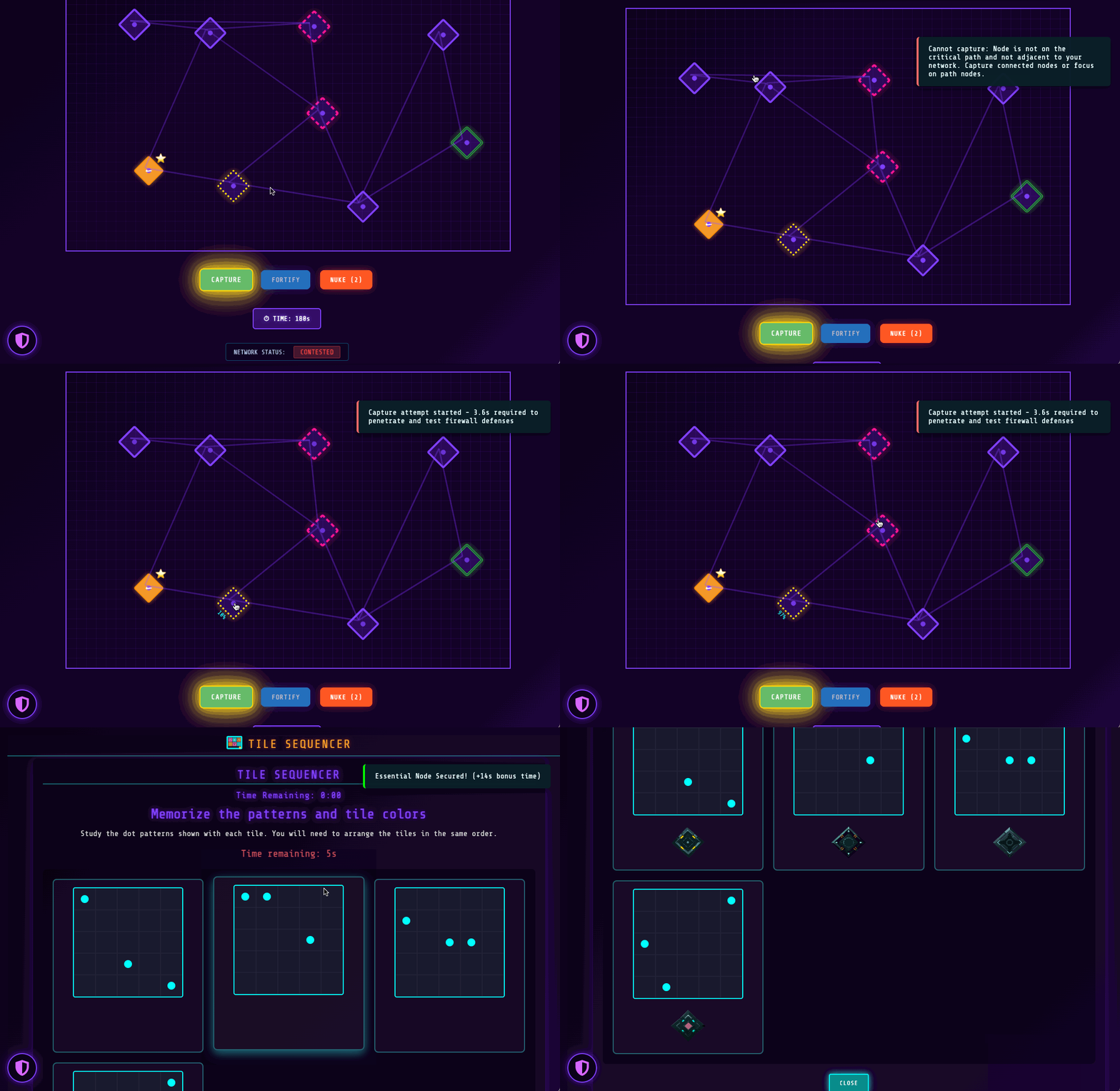
What Is Chronotrate?
Chronotrate is the third cognitive training game in Reticle Cold War—focused on speed and efficiency where Confluence emphasizes multi-domain strategy and TriDyak rewards patient calculation.
Chronotrate is a network hacking game developed in honor of a similar game introduced in the classic Deus Ex series.
Why Chronotrate Matters
The other games test deep thinking. Chronotrate tests:
| Capability | Real-World Application |
|---|---|
| Network Navigation | Strategic pathfinding through complex systems |
| Real-Time Defense | Counter-attack management against hostile AI |
| Resource Management | Efficient use of limited "nuke" bypasses |
| Pressure Performance | Maintain clarity when time is critical |
How It Works
The Challenge
You infiltrate a computer network, capturing nodes while defending against an intelligent firewall system that progressively recaptures your territory. Reach the destination node before time expires.
Network Structure
- Directed graph of interconnected nodes
- Start node (left side) - your entry point
- Destination node (right side) - your objective
- Node types: Standard, Destination, Challenge (puzzle), and Bonus
Difficulty Levels
| Difficulty | Time Limit | Characteristics |
|---|---|---|
| Easy | 180 seconds | Gentler firewall, slower decay, earlier stability |
| Medium | 120 seconds | Balanced challenge, standard firewall aggression |
| Hard | 90 seconds | Aggressive firewall, rapid decay, delayed stability |
Win and Loss Conditions
Win: Capture a designated "winning path" of nodes from start to destination before the timer expires.
Loss: Timer expires before completing the winning path, or you lose control of critical path nodes and cannot recover.
Game Flow and Phases
Phase 1: Network Discovery (CONTESTED)
- Game starts with only the start node under your control
- Begin capturing adjacent nodes
- Firewall enters attack mode after initial grace period
- High firewall aggression—defend while you advance
Phase 2: Stability Transition (STABILIZING)
- Triggered when you control 50-70% of the winning path (varies by difficulty)
- Firewall reduces attack frequency
- Fortifications decay slower
- Momentum shifts from defense to strategic progress
Phase 3: Network Secured
- Triggered when you control 75-90% of the winning path
- Firewall attacks at minimum frequency
- Fortifications nearly inactive
- Reliably maintain control and reach destination
Stability Phase Thresholds
| Difficulty | Phase 2 (Stabilizing) | Phase 3 (Secured) |
|---|---|---|
| Easy | 50% control | 75% control |
| Medium | 60% control | 85% control |
| Hard | 70% control | 90% control |
Firewall AI
The firewall is your primary adversary—an intelligent system that targets your captured nodes.
Attack Strategy
The firewall uses weighted targeting:
| Factor | Weight | Description |
|---|---|---|
| Distance to Goal | 50% | Prioritizes nodes near your destination |
| Strategic Value | 30% | Targets high-value network positions |
| Connections | 20% | Attacks well-connected nodes |
Recapture Mechanics
- Base recapture chance: 30%
- Each previous recapture increases difficulty by 10%
- Fortified nodes resist recapture based on fortification level
Fortification System
Protect your captured nodes with fortifications:
| Level | Name | Decay Time (Easy) | Protection |
|---|---|---|---|
| 0 | Vulnerable | — | None (100% firewall success) |
| 1 | Weak | 20 seconds | Basic protection |
| 2 | Medium | 30 seconds | Moderate protection |
| 3 | Strong | 45 seconds | High protection |
Note: Decay times scale dynamically with difficulty and stability phase.
Mini-Puzzles
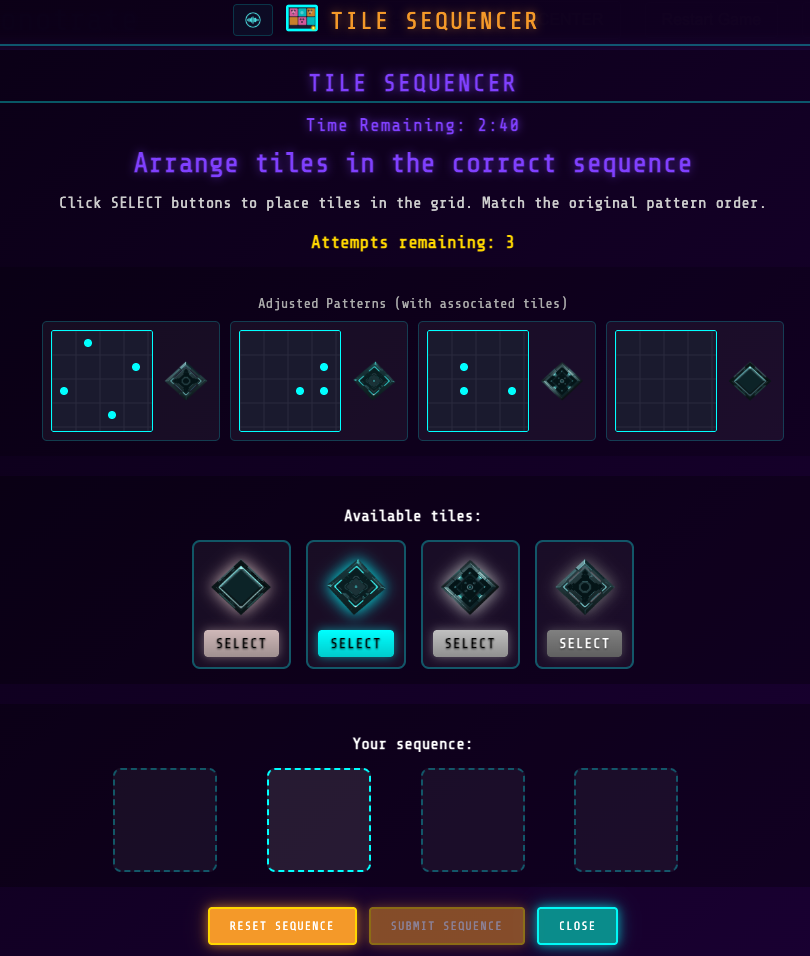
During network infiltration, you'll encounter three types of interactive challenges that unlock nodes or grant time bonuses.
Crystal Sequence
Memory-based pattern matching
- Watch a sequence of colored crystals
- Reproduce the sequence from memory
- Incorrect input resets progress and reveals sequence again
- Sequence length: 3 (Easy), 4 (Medium), 5-6 (Hard)
Tile Sequencer
Pattern recognition with transformation
- Match dot patterns to colored tiles
- Patterns are rotated/flipped during selection
- Limited attempts system
- Rewards accuracy and speed
Gem Hunter
Maze navigation challenge
- Navigate procedurally generated mazes
- Collect gems while avoiding hazards
- Time bonus scales with maze complexity and completion speed
- Maze types: Connected (linear) or Gated (teleport-based)
Time Bonuses
Successful actions grant time extensions:
| Action | Time Bonus |
|---|---|
| Node Capture | 8-15 seconds (scales with difficulty) |
| Gem Hunter Completion | 10-26 seconds |
| Tile Sequencer Success | 4-20 seconds |
| Crystal Sequence Completion | Difficulty-dependent |
| Perfect Solve (first try) | Bonus multiplier up to 1.5x |
Note: Main timer pauses during puzzles—you get dedicated time to solve them.
Skill System Integration
Your operative skills provide meaningful advantages in Chronotrate. Two skill categories affect gameplay:
Hacking Skills (Network Operations)
| Skill | Effect | Lv 1 | Lv 5 | Lv 15 | Lv 20 |
|---|---|---|---|---|---|
| Cybernetics | Node capture success | +0.4% | +1.9% | +5.6% | +7.5% |
| Information Gathering | Firewall resistance | +3.4% | +7.5% | +13% | +15% |
Information Gathering uses curved scaling—stronger gains at lower levels.
Puzzle Skills (Mini-Game Performance)
| Skill | Effect | Lv 1 | Lv 5 | Lv 15 | Lv 20 |
|---|---|---|---|---|---|
| Pattern Recognition | Solution accuracy | +0.6% | +2.8% | +8.4% | +11.3% |
| Analytical Thinking | Time penalty reduction | +1.7% | +3.8% | +6.5% | +7.5% |
Analytical Thinking uses curved scaling—stronger gains at lower levels.
Stability Phase Benefits
Your hacking skills affect when you reach stability phases. Higher skills make your control of the network feel more secure—effectively lowering the path control needed to reach Stabilizing and Secured phases.
How It Works: The game calculates an "effective stability" based on your actual path control plus a skill bonus. If your effective stability reaches a phase threshold, you enter that phase early.
| Difficulty | Skill Impact | Example |
|---|---|---|
| Easy | Mild (+5% max) | 70% control → 75% effective (enters Secured) |
| Medium | Moderate (+15% max) | 70% control → 85% effective (enters Secured) |
| Hard | Significant (+25% max) | 65% control → 90% effective (enters Secured) |
Why This Matters on Hard: Without skills, Hard mode requires 90% path control to reach the Secured phase—nearly winning before the firewall backs off. With maxed hacking skills, you can reach Secured at only 65% control, giving you breathing room to finish.
Phase Power Enhancement
Higher skill levels also strengthen phase benefits:
- Firewall attacks come less frequently (longer intervals)
- Fortifications decay more slowly
- Capture attempts against fortified nodes succeed more often
Scoring System
Base Scoring
| Achievement | Points |
|---|---|
| Puzzle completion | 20-150 (difficulty-dependent) |
| Perfect solve (first try) | Bonus points |
| Network capture efficiency | Variable |
Rewards
| Achievement | Reward |
|---|---|
| Game completion | XP scaled by difficulty |
| Puzzle performance | Skill point distribution |
| Perfect solves | Bonus skill awards |
Strategic Tips
General Principles
- Prioritize path nodes — Non-path nodes are distractions
- Manage fortifications — Keep critical nodes protected
- Use nukes strategically — Save them for fortified blockers
- Accept puzzle pauses — Timer stops during puzzles; don't panic
By Game Phase
Phase 1 (Contested):
- Move quickly along the winning path
- Don't overextend—firewall is aggressive
- Fortify nodes immediately after capture
Phase 2 (Stabilizing):
- Consolidate gains
- Use reduced firewall pressure to advance
- Complete puzzles for time bonuses
Phase 3 (Secured):
- Push to destination
- Firewall is minimal threat
- Focus on finishing quickly
Cognitive Training Benefits
Chronotrate develops distinct capabilities:
| Skill | How Chronotrate Develops It |
|---|---|
| Rapid Assessment | Evaluate network topology quickly |
| Prioritization | Identify critical path vs. distractions |
| Multi-tasking | Balance offense, defense, and puzzles |
| Stress Performance | Maintain effectiveness under time pressure |
These skills complement Confluence (strategic depth) and TriDyak (patient calculation).
The Three-Game System
Chronotrate completes the cognitive training triad:
| Game | Tests | Playstyle |
|---|---|---|
| Confluence | Multi-domain strategy | Deliberate, adaptive |
| TriDyak | Spatial calculation | Patient, precise |
| Chronotrate | Speed efficiency | Rapid, decisive |
Together, they develop the full range of operative cognitive capabilities.
Getting Started
Day 1: Orientation
- Complete tutorial scenarios
- Attempt Easy difficulty to learn network mechanics
- Observe firewall behavior and puzzle types
Week 1: Foundation
- Complete daily Easy challenges
- Learn winning path identification
- Practice puzzle mini-games
- Build fortification habits
Week 2: Acceleration
- Progress to Medium difficulty
- Master stability phase transitions
- Optimize time bonus collection
Ongoing: Mastery
- Tackle Hard difficulty
- Minimize time to completion
- Achieve consistent wins across all difficulties
Common Mistakes
Mistake: Ignoring fortifications Fix: Fortify captured nodes immediately—decay is constant
Mistake: Using nukes early Fix: Save nukes for fortified nodes blocking critical path
Mistake: Overextending during Phase 1 Fix: Consolidate before the firewall overwhelms you
Related Systems
- Mini-Games Overview — The complete training system
- Confluence — Strategic depth training
- TriDyak — Spatial calculation training
- Skills — How training affects progression