Confluence
A strategic card game of domain influence and capture—where controlling four battlefields simultaneously determines victory.
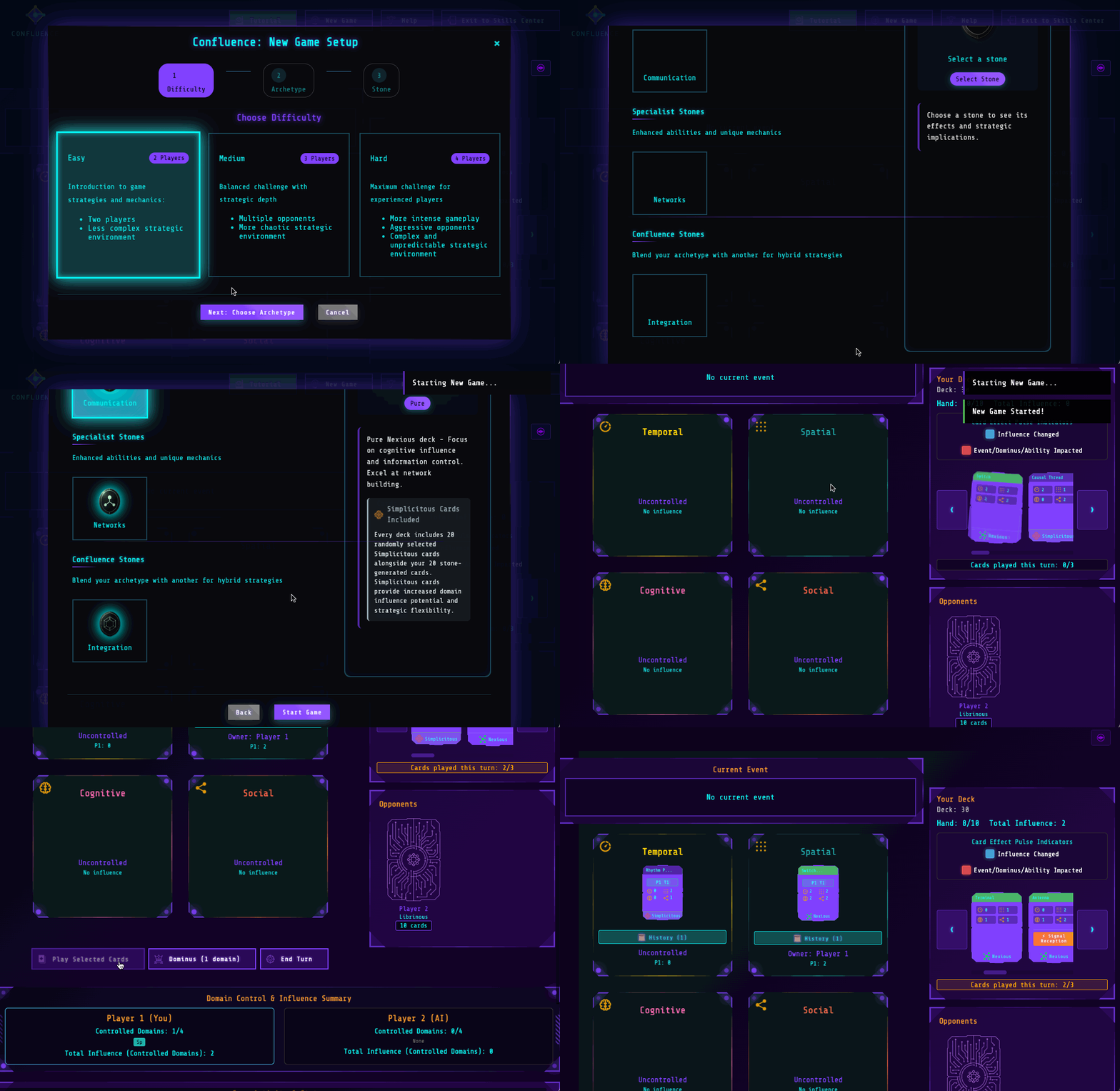
What Is Confluence?
Confluence is a strategic card game where players compete to exert influence across four domains—Temporal, Spatial, Cognitive, and Social—using cards with varying influence values. By outpacing your opponent's influence in a domain, you capture their cards and gain control.
The game combines deck composition strategy with tactical card placement, rewarding players who can think across multiple dimensions simultaneously.
If You've Played Other Card Games
Confluence draws inspiration from several strategic card games you may know:
Similar to Gwent (The Witcher)
- Playing cards to separate rows (Gwent has 2 rows; Confluence has 4 domains)
- Numerical values that determine who wins each area
- Best-of-rounds structure with strategic card commitment
- Building toward specific point thresholds
Similar to Magic: The Gathering
- Deck archetypes with distinct playstyles (aggro, control, tempo)
- Card abilities that trigger on play or under conditions
- Strategic depth requiring multi-turn planning
- Counter-play between offensive and defensive strategies
Similar to Triple Triad (Final Fantasy)
- Cards have values in multiple directions (Triple Triad: 4 sides on a 3x3 grid; Confluence: 4 domains)
- Capture mechanics based on higher numbers beating adjacent lower numbers
- Positional strategy matters—where you play affects what you capture
What Makes Confluence Different
- Four simultaneous battlefields — Unlike lane-based games with 2-3 rows, you manage 4 domains at once
- Capture pile system — Captured cards go to your capture pile (removed from play, not destroyed)
- Dominus Points — A unique resource system generated by domain control
- Events are systemic — Random events affect gameplay beyond just card abilities
- Multiple victory paths — Win through domain control (Convergence), total influence (Dominance), or outlasting (Time Limit)
If you're new to strategic card games, Confluence is an accessible entry point—simpler than Magic's mana system, but with strategic depth similar to Gwent's positional play.
Why Confluence Matters
While Chronotrate tests speed and TriDyak tests spatial calculation, Confluence tests:
| Capability | Real-World Application |
|---|---|
| Multi-Domain Thinking | Managing simultaneous priorities |
| Strategic Adaptation | Adjusting plans as situations evolve |
| Resource Management | Optimizing limited assets across competing needs |
| Pattern Recognition | Reading opponent strategies and card interactions |
Confluence develops the ability to see complex situations holistically.
Core Mechanics
The Four Domains
Every card has influence values (0-4) across four domains. You play cards to domains to build influence:
| Domain | Focus | Strategic Role |
|---|---|---|
| Temporal | Time and sequence | Turn order, delayed effects, timing |
| Spatial | Position and area | Territory control, positioning |
| Cognitive | Knowledge and thought | Information control, prediction |
| Social | Relationships and influence | Alliances, reputation, collective actions |
Card Placement and Capture
When you play a card to a domain:
- Your influence in that domain increases by the card's value
- If your total influence exceeds your opponent's, you capture all their cards in that domain
- Captured cards transfer to your captured pile
- You gain control of the domain
Higher influence captures lower—making every card placement a calculated risk.
Turn Structure
Each turn follows this sequence:
Draw Phase — Draw cards (1 archetype + 2 common cards)
Event Phase — System checks for random events that affect gameplay
Action Phase — Play up to 3 cards to domains
Resolution Phase — Compare influence, resolve captures, check victory
The Five Archetypes
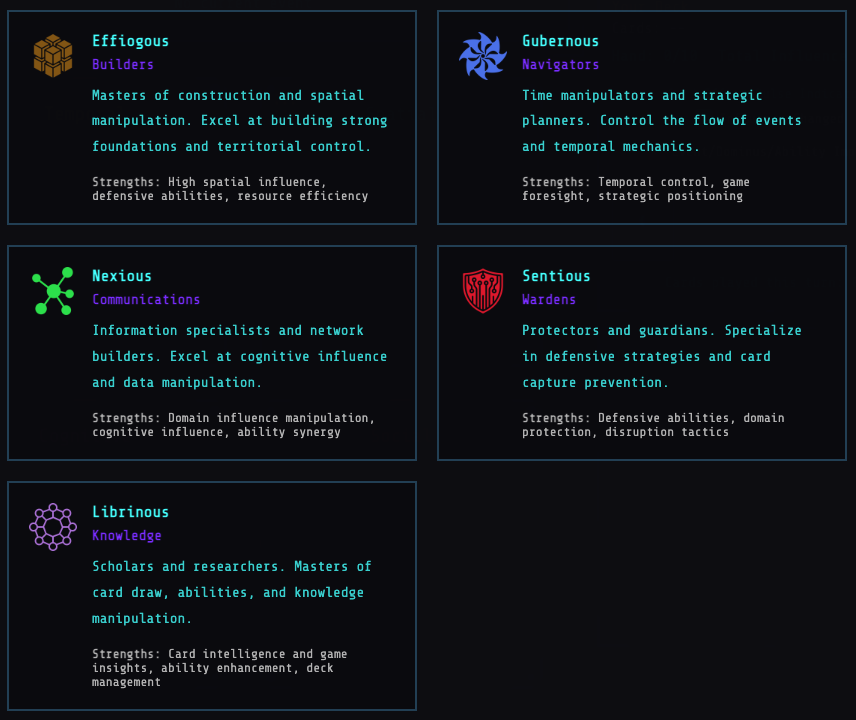
Choose an archetype that determines your deck composition and strategic focus. Each has distinct domain strengths.
Effiogous — The Builders
Focused on Spatial and Temporal domains
- Excel at establishing board presence
- Strong territory control
- Build advantages over time
Gubernous — The Governors
Emphasize Tempo and Control balance
- Balanced across multiple domains
- Control the pace of the game
- Adaptable strategies
Nexious — The Communicators
Prioritize Value and Social influence
- Strong in Social domain
- Card advantage through connections
- Build synergies between cards
Sentious — The Wardens
Focus on Defense and Control
- Protect your domains from capture
- Disruptive abilities
- Excel at preventing opponent progress
Librinous — The Knowledge Seekers
Combine Value and Aggression
- Strong in Cognitive domain
- Information advantage
- Aggressive capture strategies
Victory Conditions
Four paths to victory exist. Choose your strategy wisely.
Convergence Victory
Control 3 domains simultaneously
Control 3 of 4 domains at once to achieve Convergence Victory. This requires balanced influence across multiple domains and rewards versatile deck management.
Dominance Victory
Reach 35 total influence while controlling at least one domain
Total influence is the sum across ALL domains, not just one. You must also control at least one domain. The threshold is 35 influence for all difficulty levels.
Time Limit Victory
Highest influence when turn limit is reached
| Difficulty | Turn Limit |
|---|---|
| Easy | 20 turns |
| Medium | 25 turns |
| Hard | 28 turns |
If no other victory is achieved, the player with the highest total influence wins. Prevents infinite games.
Deck Depletion Victory
Highest influence when a deck is exhausted
Rare condition when all cards are drawn. Victory goes to the player with the most influence at that moment.
Card Types
Cards are associated with special stones (three for each archetype) that determines deck composition. Players can choose to:
- Focus entirely on archetype strengths
- Lean in to card abilities
- Blend synergistic archetypes
Archetype Cards
Powerful cards specific to your chosen archetype. Drawn once per turn. Often have special abilities that trigger on play, capture, or other conditions.
Common Cards
Balanced generic cards that fill out your hand. No abilities—purely numerical influence values.
- Distributed across tiers: high (25%), medium (50%), low (25%)
- Total influence range: 2-5 per card
- Maximum 2 influence per individual domain
Event Cards
Special cards triggered by the game system. Create temporary conditions affecting gameplay—may boost or penalize certain domains or actions.
Card Abilities
Archetype cards often have special abilities that trigger under specific conditions. Understanding abilities is key to maximizing your strategy.
Note: The abilities shown below are representative examples from each archetype, not a complete list. With more than 40 unique abilities across all archetypes, there are many more to discover through gameplay.
Ability Effect Types
| Effect Type | What It Does |
|---|---|
| Influence Boost | Increases influence values on your cards |
| Influence Manipulation | Redistributes influence between domains on a card |
| Protection | Shields cards or domains from negative effects |
| Domain Lock | Prevents card movement to/from a domain |
| Card Draw | Lets you draw additional cards |
| Card Move | Relocates cards between domains |
| Preview | Reveals information about opponent, deck, or events |
| Multiplier | Applies percentage-based boosts |
| Forced Discard | Makes opponents discard cards |
Effiogous Abilities — The Builders
Focus: Board stability, territory protection, construction synergies
| Card | Ability | Type | Effect |
|---|---|---|---|
| Effiogous Prime | Construction Boost | Multiplier | Play your next card to 2 domain territories simultaneously |
| Effiogous Architect | Structural Enhancement | Protection | Protect target domain from influence reduction for 2 turns |
| Effiogous Foundation | Stability Field | Domain Lock | Lock target domain—no cards can move to or from it this turn |
| Effiogous Weaver | Pattern Weaving | Influence Boost | Gain +1 influence on all your played cards |
| Effiogous Designer | Blueprint Creation | Preview | Optimize hand order and deck arrangement for maximum efficiency |
Playstyle Tip: Effiogous abilities excel at protecting what you've built. Use Stability Field to lock down a domain you control, then stack cards there safely.
Gubernous Abilities — The Navigators
Focus: Temporal control, information gathering, adaptive repositioning
| Card | Ability | Type | Effect |
|---|---|---|---|
| Gubernous Navigator | Temporal Mastery | Influence Manipulation | Redistribute up to 3 opponent influence between their card's domains |
| Gubernous Timekeeper | Chronos Control | Preview | Modify a future event's timing and increase its likelihood |
| Gubernous Wayfinder | Dimensional Sight | Preview / Forced Discard | Look at opponent's hand and force them to discard 1 card |
| Gubernous Pilot | Course Correction | Card Move | Move up to 2 of your cards to their optimal domains |
| Gubernous Scout | Reconnaissance | Preview | Look at opponent's next 2 cards and assess their threat level |
Playstyle Tip: Gubernous abilities give you information advantage. Use Dimensional Sight early to see opponent threats, then Chronos Control to manipulate events in your favor.
Nexious Abilities — The Communicators
Focus: Network effects, card synergies, domain connections
| Card | Ability | Type | Effect |
|---|---|---|---|
| Nexious Transmitter | Signal Amplification | Multiplier | Increase your influence in target domain by 25% this turn |
| Nexious Relay | Network Bridging | Influence Boost | Connect 2 domains—cards in one gain influence equal to the other |
| Nexious Network | Distributed Processing | Card Move | Redistribute up to 3 of your played cards across domains |
| Nexious Encoder | Data Encryption | Protection | Protect target domain from manipulation for 2 turns |
| Nexious Router | Traffic Direction | Card Move | Move any 2 played cards (yours or opponent's) between domains |
Playstyle Tip: Nexious abilities create powerful synergies. Use Network Bridging to make a weak domain benefit from a strong one, then Signal Amplification for burst influence.
Sentious Abilities — The Wardens
Focus: Defense, lockdown, opponent disruption
| Card | Ability | Type | Effect |
|---|---|---|---|
| Sentious Guardian | Protective Field | Protection | Shield target domain from all negative effects for 3 turns |
| Sentious Fortress | Immovable Defense | Domain Lock | Lock target domain—no cards can move to or from it for 2 turns |
| Sentious Snare | Entrapment | Domain Lock | Lock opponent's strongest domain for 2 turns |
| Sentious Patrol | Perimeter Sweep | Card Move | Move up to 2 opponent cards to their weakest domains |
| Sentious Guard | Crowd Control | Forced Discard | Force all opponents to discard 2 cards from hand |
Playstyle Tip: Sentious abilities shut down opponent options. Use Entrapment to lock their strongest domain, then Perimeter Sweep to scatter their other cards.
Librinous Abilities — The Knowledge Seekers
Focus: Card advantage, information, cognitive dominance
| Card | Ability | Type | Effect |
|---|---|---|---|
| Librinous Scholar | Knowledge Synthesis | Card Draw | Draw 3 cards, then discard your weakest card |
| Librinous Sage | Wisdom Sharing | Influence Boost | All your cards gain cognitive influence based on hand size |
| Librinous Oracle | Future Sight | Preview | Preview potential events and make unwanted ones less likely |
| Librinous Curator | Collection Management | Card Move | Retrieve up to 3 cards from discard pile to hand |
| Librinous Index | Quick Reference | Preview | Access detailed game state info including victory proximity and opponent deck composition |
Playstyle Tip: Librinous abilities maximize card advantage. Use Knowledge Synthesis for card draw, then Wisdom Sharing when your hand is full for massive cognitive boosts.
Special: Lock Hacker
Some cards have the Lock Hacker ability, which removes all locks and protections from domains. This is a rare counter to defensive strategies:
- Gubernous Pathbreaker and Librinous Penetrator both have this ability
- Use it to break through Sentious lockdowns or remove protective fields
Ability Strategy Tips
- Timing matters — Some abilities (like Construction Boost) affect your next play, so plan ahead
- Stack protections — Multiple protection abilities on one domain create a fortress
- Counter-play exists — Lock Hacker can break defensive setups
- Duration awareness — Track how long protections and locks last (2-4 turns typically)
- Synergy chains — Combine abilities: use Network Bridging to boost a domain, then Signal Amplification for +25% more
Deck Building
Affinity Stones
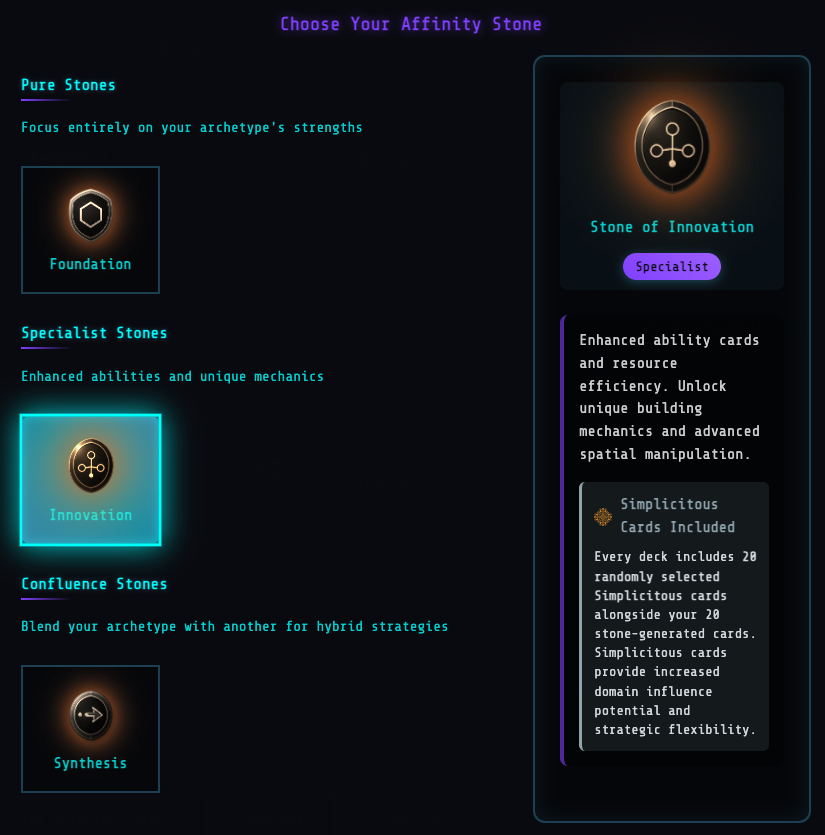
Affinity stones modify your deck composition before the game begins:
| Stone Type | Effect |
|---|---|
| Pure | 100% archetype cards (highly specialized) |
| Confluence | Mix of two aligned archetypes (balanced) |
| Specialist | Heavy concentration in specific domain |
Choose your stone based on your victory strategy—Pure for archetype synergies, Confluence for flexibility, Specialist for domain dominance.
Deck Composition
- Minimum 20 cards
- 40-60% archetype cards (varies by stone)
- 40-60% common cards (filler)
- Starting hand: 7 cards
- Hand limit: 10 cards maximum
- Per turn draw: 1 archetype + 2 common cards
- 2 deck reshuffles allowed per game
Strategic Approaches
Tempo Strategy
(Effiogous/Gubernous)
- Play high-influence cards early
- Establish control before opponent builds up
- Win through early convergence
Value Strategy
(Nexious/Librinous)
- Accumulate card advantage over time
- Use abilities that generate resources
- Outlast opponent in late game
Control Strategy
(Sentious/Gubernous)
- Dominate specific domains completely
- Prevent opponent captures
- Win through domain lockdown
Aggression Strategy
(Librinous/Sentious)
- Focus on capturing opponent cards
- Pressure opponents into poor trades
- Win through dominance from captured influence
Events System
During each turn's Event Phase, the game may trigger random events that affect gameplay. Events create dynamic situations requiring adaptation.
Event Types
| Effect Type | What It Does |
|---|---|
| Influence Boost | Increases card influence values in target domains |
| Influence Reduction | Decreases card influence values |
| Card Swap/Move | Moves cards between domains or players |
| Hand Manipulation | Affects drawing and hand composition |
| Archetype Boost | Buffs cards of a specific archetype |
| Victory Modification | Temporarily changes victory thresholds |
| Domain Lock | Prevents playing to specific domains |
| Global Modifier | Applies game-wide changes |
Event Rarity
| Rarity | Frequency | Impact |
|---|---|---|
| Common (50%) | Frequent | Mild effects—small influence changes, minor draws |
| Uncommon (30%) | Moderate | Situational benefits—archetype bonuses, targeted effects |
| Rare (15%) | Infrequent | Game-changing—victory modifications, major board shifts |
| Epic (5%) | Very rare | Extreme impact—full board resets, cascade events |
Notable Events
Stellar Alignment — Boosts influence in a random domain (+1 to +3)
Cognitive Storm — Reduces cognitive domain influence for 2 turns
Knowledge Surge — All players draw 1-2 additional cards
Archetype Awakening — Cards of a specific archetype gain +2 influence in their specialty domain (2 turns)
Domain Lockdown — Prevents new cards being played to the most contested domain (3 turns)
Primal Chaos — All cards return to players' hands, domains reset (Epic rarity)
Convergence Shift — Temporarily changes the convergence victory threshold
Strategic Adaptation
Events reward flexible thinking:
- Watch event timing — Rare events tend to appear mid-game (turns 5-12)
- Control domains — Controlling a domain provides some protection from event disruption
- Bank your moves — If a beneficial event triggers, capitalize immediately
Dominus Points
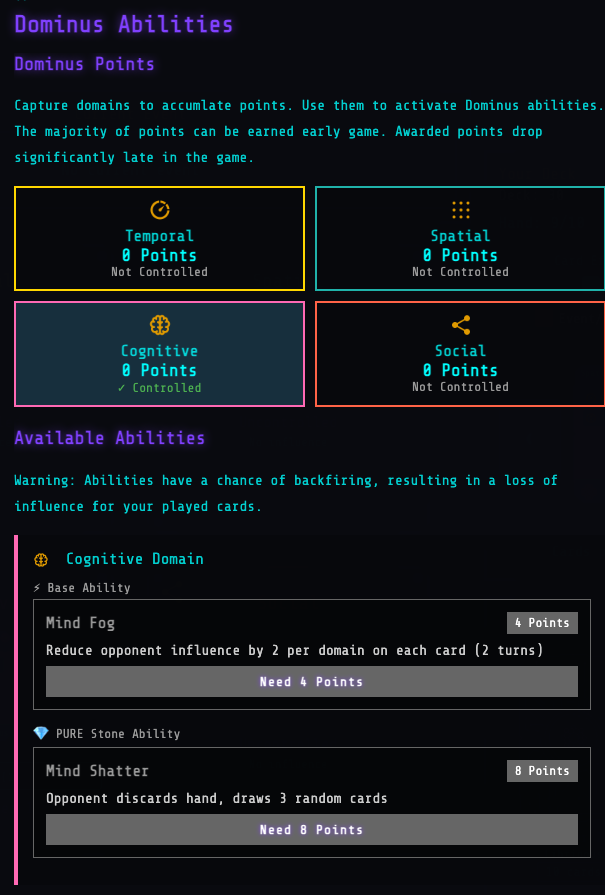
Dominus Points are a resource generated by controlling domains. They power special abilities that can turn the tide of battle.
Earning Dominus Points
Generation occurs during the Resolution Phase when you control a domain.
| Game Phase | Base Generation | Maximum Pool |
|---|---|---|
| Early (turns 1-5) | 2 points/domain | 8 points |
| Mid (turns 6-12) | 3 points/domain | 12 points |
| Late (turns 13+) | 2 points/domain | 15 points |
Archetype Scaling:
- Librinous: +15% generation (aggressive playstyle)
- Effiogous: -15% generation (defensive focus)
- Gubernous, Nexious, Sentious: Standard rate
Stone Bonuses:
- Specialist stones grant +1 point when generating in their specialty domain
- Confluence stones grant +1 point when controlling multiple domains
Point Decay
Points slowly decay each turn to prevent excessive banking:
- Early game: Minimal decay (0-1 points)
- Mid game: Light decay when over threshold
- Late game: Preserved points remain valuable
Points decay faster when you lose control of a domain.
Base Abilities (Cost: 4 Points)
Available when you control a domain and have 4+ points in that domain:
| Domain | Ability | Effect |
|---|---|---|
| Temporal | Time Flux | Return up to 4 opponent cards from domains to their deck |
| Spatial | Domain Shuffle | Randomly move 3 cards between all domains |
| Cognitive | Mind Fog | Reduce opponent influence by 2 per domain on each card (2 turns) |
| Social | Social Pressure | Force opponent to discard up to 4 cards from hand |
Stone Abilities (Cost: 8 Points)
More powerful abilities unlocked by your affinity stone choice:
Pure Stone Abilities
| Domain | Ability | Effect |
|---|---|---|
| Temporal | Chronos Echo | Double your card influence this turn only |
| Spatial | Reality Fracture | Swap all cards between the two domains with most cards |
| Cognitive | Mind Shatter | Opponent discards hand, draws 3 random cards |
| Social | Social Collapse | All players lose 3 influence in controlled domains |
Specialist Stone Abilities
| Domain | Ability | Effect |
|---|---|---|
| Temporal | Temporal Weakness | Reduce target card influence by 3 (2 turns) |
| Spatial | Spatial Distortion | Move up to 3 opponent cards to their worst domains |
| Cognitive | Memory Wipe | Reset up to 3 opponent cards to base influence values |
| Social | Influence Drain | Steal 2 influence from target opponent |
Confluence Stone Abilities
| Domain | Ability | Effect |
|---|---|---|
| Temporal | Time Lock | Lock opponent's 2 strongest domains from changes (3 turns) |
| Spatial | Phase Lock | Prevent card movement in all domains (2 turns) |
| Cognitive | Neural Bridge | Copy up to 3 of opponent's strongest cards to your hand |
| Social | Mass Suggestion | Opponent's next card plays go to random domains |
Grace Period
If you lose control of a domain but still have points:
- You can still use abilities, but at +3 cost (base) or +4 cost (stone)
- This allows defensive plays when losing ground
- Recapture the domain to restore normal costs
Chaos Factor
Stone abilities have a chance to misfire and trigger an unexpected effect:
- 15% chaos chance when controlling the domain
- 30% chaos chance during grace period (domain not controlled)
- Chaos triggers a random ability instead of the intended one
Strategic Use
Early Game: Focus on generating points—control domains to bank resources
Mid Game: Activate abilities to swing momentum—this is peak generation
Late Game: Points are precious—use them for victory pushes or disruption
Timing Matters:
- Use Mind Fog before a capture attempt to weaken opponent cards
- Use Time Flux to remove threatening cards before they capture yours
- Save Chronos Echo for a Dominance victory push
Difficulty Scaling
| Setting | Convergence | Dominance | Turn Limit |
|---|---|---|---|
| Easy | 3/4 domains | 35 influence | 20 turns |
| Medium | 3/4 domains | 35 influence | 25 turns |
| Hard | 3/4 domains | 35 influence | 28 turns |
Note: Victory thresholds are currently uniform across difficulties. The primary difference is game length—Easy gives you more turns to achieve victory.
Getting Started
Day 1: Learn the Basics
- View the tutorial
- Try one match on Easy difficulty
- Understand domain capture mechanics
Week 1: Explore Archetypes
- Play each archetype at least once
- Note which playstyle feels natural
- Start focusing on one archetype
Week 2: Refine Strategy
- Experiment with different affinity stones
- Learn common card synergies
- Practice against Medium difficulty AI
Ongoing: Master the Game
- Challenge Hard difficulty
- Master all victory conditions
- Learn to read opponent strategies
Tips for Improvement
- Watch domain totals — Know when you or your opponent threatens Convergence or Dominance
- Balance offense and defense — Overcommitting to one domain leaves others vulnerable
- Count cards played — Track what's been used to predict remaining threats
- Use events wisely — Event abilities can swing domain control
- Adapt to your opponent — Rigid strategies lose to flexible thinking
Cognitive Training Benefits
| Skill | How Confluence Develops It |
|---|---|
| Pattern Recognition | Identify card interactions and opponent strategies |
| Analytical Thinking | Evaluate complex multi-domain situations |
| Strategic Planning | Plan multiple turns ahead |
| Risk Assessment | Evaluate capture trade-offs under uncertainty |
The Three-Game System
Confluence fits into the cognitive training triad:
| Game | Tests | Playstyle |
|---|---|---|
| Confluence | Multi-domain strategy | Deliberate, adaptive |
| TriDyak | Spatial calculation | Patient, precise |
| Chronotrate | Speed efficiency | Rapid, decisive |
Together, they develop the full range of operative cognitive capabilities.
Related Systems
- Mini-Games Overview — The complete training system
- Chronotrate — Speed and efficiency training
- TriDyak — Spatial calculation training
- Skills — How training affects progression