TriDyak Board Game
A custom abstract strategy game with AI built to professional standards—featuring a 750,000+ position opening book and purpose-trained neural network.
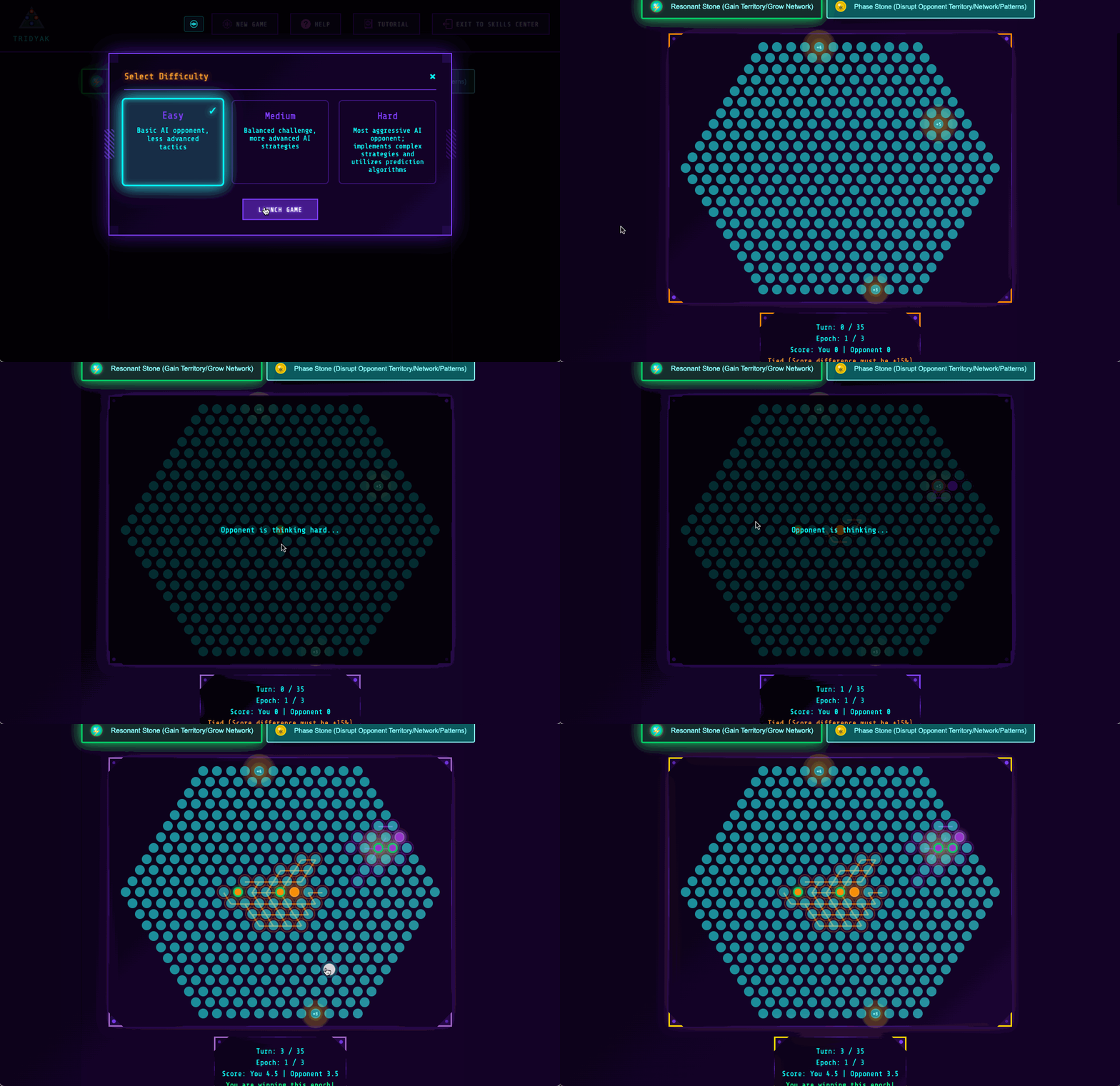
How to Play (Quick Start)
Your Turn
On each turn, you place one stone on any empty position. Choose between two stone types:
| Stone Type | What It Does |
|---|---|
| Resonant | Projects strong influence (10.0) up to 3 positions away. Use for building territory. |
| Phase | Projects weaker influence (6.0) up to 4 positions away, but has 75% chance to disrupt opponent's influence. Use for attacking. |
Stone supply is unlimited—choose freely each turn based on your tactical needs.
How Influence Works
Each stone radiates influence outward. Influence weakens with distance:
- Adjacent positions receive nearly full influence
- 2 positions away receives reduced influence (~80% of previous)
- 3+ positions away receives further reduced influence
You control a position when your total influence there exceeds your opponent's. The bigger your lead, the stronger your control:
| Territory Tier | What It Means |
|---|---|
| Strong | Large influence advantage—secure territory |
| Weak | Moderate advantage—vulnerable to contest |
| Contested | Small advantage—could flip with one stone |
Territory Entrenchment: Established territories become harder to disrupt as the game progresses:
- Early game (turns 1-10): Stones project weaker influence (starting at 30%, scaling to full strength)
- Strong territories resist Phase stone disruption—85% of disruption effect is blocked
- Weak territories resist moderately—70% of disruption effect is blocked
This means early territorial claims matter. If you let your opponent establish strong territory early, it becomes increasingly costly to contest later. Conversely, protecting your early gains pays compounding dividends.
Territory Control Example:
    Your Stone [R]               Opponent Stone [P]
         │                             │
         ▼                             ▼
       · · ·                         · · ·
      · ▓ ▓ ·                       · ░ ░ ·
     · ▓ R ▓ ·                     · ░ P ░ ·
      · ▓ ▓ ·                       · ░ ░ ·
       · · ·                         · · ·

    ▓ = Your territory (strong near stone, weaker at edges)
    ░ = Opponent territory
    · = Neutral/contested

    Where influence overlaps → territory is contested
    The player with MORE total influence at a position controls it
How to Score Pattern Points
Patterns: Form geometric shapes with your stones inside territory you control:
| Pattern | Shape | Points |
|---|---|---|
| Triad | Three adjacent stones forming a triangle | ~10 points |
| Lock | Four stones in a diamond (center + three corners) | ~15 points |
Pattern Examples:
    TRIAD (~10 pts)              LOCK (~15 pts)

        ●                            ●
       / \                          /|\
      ●───●                        ● │ ●
                                    \|/
    3 stones, all                    ●
    mutually adjacent
                               4 stones in diamond:
                               center + 3 corners
                               (all adjacent to center)
Key Rule: Patterns only count if they're inside YOUR territory. Stones placed in enemy territory won't form scoring patterns.
Territory: You earn small points each turn based on how much territory you control.
Capture Warning: If your opponent takes more than 50% of a pattern's territory, you lose the pattern's full point value—and they gain half of it. Protect your patterns.
Winning
Matches are best-of-three epochs (games). Each epoch has a set number of turns (typically 35).
- Win an epoch by scoring 15% more than your opponent when turns run out
- Win 2 epochs to win the match
- Close scores result in a draw for that epoch
Special Events: Resonance Storms
1-3 times per epoch, resonance storms randomly shift influence across the board. You'll see upcoming storms in the event display. Diversify your position—don't put all your influence in one region.
Game Overview
TriDyak is a custom-designed strategic board game with AI engineered using the same techniques used in world-class Chess and Go programs:
- 750,000+ opening book positions — Like Chess grandmasters, the AI draws on a library of studied moves rather than guessing. You face intelligent play from the first stone.
- Neural network evaluation — The AI "sees" the board holistically, recognizing patterns and evaluating positions the way experienced players do.
- Adaptive difficulty — Three skill levels (Easy, Medium, Hard) with automatic escalation if you're winning too easily.
If you enjoy Go, Hex, or Hive, you'll find TriDyak familiar yet refreshingly different.
If You've Played Other Abstract Strategy Games
TriDyak draws inspiration from several classic games you may know:
From Go — TriDyak borrows abstract territory control and deep strategic complexity. But where Go scores territory by surrounding empty space with stones, TriDyak uses influence projection—your stones radiate control outward, and territory is determined by who has stronger influence at each position.
From Hex — TriDyak uses a hexagonal grid and shares the "place once, never move" mechanic. But where Hex has a single goal (connect your two sides), TriDyak combines territory control with pattern completion—you're building influence networks while trying to form scoring patterns.
From Hive — TriDyak shares the concept of multiple piece types with different abilities. But where Hive pieces move constantly across an infinite plane to surround the opponent's Queen, TriDyak stones are permanent once placed—your strategic decisions are final.
"This looks like Go—how is it different?"
In Go, you surround empty space to claim it. Territory is binary: yours or not yours. Stones can be captured and removed from the board.
In TriDyak, you don't surround—you radiate. Each stone projects influence outward that weakens with distance. Territory isn't binary; it exists in tiers (strong, weak, contested) based on who has more influence at each position. Your stones are never removed—but your territory can shift as your opponent projects competing influence.
This creates a fundamentally different game feel:
- Go rewards encirclement — you build walls to claim space inside them
- TriDyak rewards positioning — you place stones where their influence overlaps and reinforces
The two stone types add another layer Go doesn't have. In Go, every stone is identical. In TriDyak, choosing Resonant (stronger, shorter range) vs Phase (weaker, longer range, disrupts opponent) is a tactical decision on every turn.
Finally, TriDyak's best-of-three epoch structure means a single game doesn't decide the match. You can lose an epoch, adapt your strategy, and come back.
How TriDyak Works
The Board
A diamond-shaped hexagonal grid with 397 positions. Influence radiates outward from placed stones.
The Pieces
Two stone types create different influence patterns:
| Stone Type | Range | Base Influence | Special Effect |
|---|---|---|---|
| Resonant Stones | 3 positions | 10.0 | Strong, permanent territory expansion |
| Phase Stones | 4 positions | 6.0 | Disrupts opponent influence (75% chance), effect fades over ~3 turns |
Influence decays with distance—a stone's effect weakens the farther you get from it.
Phase Stone Timing: Phase stone disruption effects are temporary—they decay over approximately 3 turns. This means early-game phase placements lose effectiveness by mid-game. Time your disruption plays for when they matter most, not as opening moves.
The Goal
Control territory through influence projection. Victory comes from:
- Forming required patterns in controlled territory (triads: 3 pieces, locks: 4 pieces)
- Winning more epochs than your opponent (best of 3)
- Balancing territory expansion with pattern completion
Best-of-Three Epochs
Matches consist of up to three epochs. Each epoch is a complete game:
| Epoch Type | Turns per Epoch | Gameplay Style |
|---|---|---|
| Standard | 35 turns | Balanced strategic play |
| Turbo | 20 turns | Fast, aggressive games |
| Marathon | 50 turns | Extended strategic development |
Epoch Rules:
- Win an epoch by having 15%+ higher score when turns run out
- Board resets between epochs
- Win 2 epochs to win the match
- If tied 1-1, epoch 3 decides (or cumulative score if all epochs draw)
Resonance Storms
Each epoch includes 1-3 resonance storms—random events that disrupt the board state. Storms add unpredictability and prevent purely calculated play from dominating.
| Storm Type | Frequency | Effect |
|---|---|---|
| Influence Shift | 50% | Redistributes influence across contested territories |
| Resonance Boost | 30% | Amplifies one player's existing influence patterns |
| Pattern Disruption | 20% | Weakens established patterns, creating openings |
Storm Strategy:
- Storms favor players with diversified positions—don't put all your influence in one region if you receive a storm warning
- The leading player often benefits less from storms than the trailing player
The AI Opponent
TriDyak's AI is purpose-built.
Opening Book: 750,000+ Positions
An opening book is a database of studied positions and their best responses—the same technique used by world-class Chess engines like Stockfish and professional Go programs like AlphaGo. Rather than calculating every position from scratch, the AI draws on accumulated knowledge of what works.
TriDyak's opening book contains over 750,000 catalogued positions:
- Bayesian confidence scores — Statistical certainty levels for each move recommendation
- Win rate tracking — Historical success rates inform move selection
- Continuous learning — The book grows as new games are played
- Strategic classification — Positions tagged by opening type and recommended strategy
This approach mirrors how human experts develop opening repertoires—through study, pattern recognition, and accumulated experience.
Custom Neural Network
A neural network (~18,000 parameters) trained specifically on TriDyak:
- Four areas of focus: move quality, strategy alignment, strategy effectiveness, pivot signal
- Learns from self-play games through continuous training
- Understands TriDyak-specific positional concepts
- Evaluates board states in milliseconds
What this means: The AI understands the game. It evaluates positions holistically.
Bayesian Confidence Scoring
The AI knows how confident it is in each position:
| Confidence Level | What It Means |
|---|---|
| Very High | Position is clearly evaluated, optimal play known |
| High | Strong understanding, few uncertainties |
| Medium | Multiple plausible approaches, position is contested |
| Low | Novel position, AI is exploring |
| Very Low | Unknown territory, AI is learning |
What this means: Novel positions challenge both players.
Adaptive Difficulty
The AI adjusts to challenge you appropriately:
| Difficulty | AI Behavior |
|---|---|
| Easy | Picks from top 5 candidate moves (introduces exploitable mistakes for learning) |
| Medium | Picks from top 3 candidate moves (balanced, competitive play) |
| Hard | Always picks the best evaluated move (full strength) |
The AI uses the same strategic intelligence at all levels—the difference is execution precision. Lower difficulties create patterns you can exploit while learning.
Auto-Escalation: If you dominate an epoch by 30%+ margin, the AI automatically escalates to the next difficulty level. This prevents farming easy wins.
What this means: The AI matches your skill. Learn at Easy, compete at Medium, test yourself at Hard.
Strategic Concepts
The Three Core Strategies
The AI uses three distinct strategic approaches. Understanding when to use each is key to strong play.
Expansion — Build your network outward
- Place stones adjacent to your existing territory
- Use Resonant stones for network building (stronger, shorter range)
- Spread out from center early—controlling more board area creates options
- Best in: Early game (first 20% of turns)
Disruption — Interfere with opponent territory
- Place stones inside opponent territory to weaken their control
- Target their strong (uncontested) territories for maximum impact
- Use Phase stones for disruption (wider range, 75% chance to disrupt)
- Best in: Mid-game when positions are contested
Consolidation — Strengthen what you have
- Protect territories you're winning
- Block opponent pattern formations
- Use when you have a score lead you need to protect
- Best in: Late game when defending a lead
Game Phase Strategy
Early Game (turns 1-7 in Standard)
- Focus on expansion—spread influence across the board
- Avoid committing to one area; keep options open
- Resonant stones build stronger initial networks
Mid-Game (turns 8-21 in Standard)
- Disruption becomes highly effective—actively contest opponent territory
- Don't play reactively; be deliberate about where you place
- The player who controls the contested zones usually wins
Late Game (turns 22-35 in Standard)
- Pattern completion matters most—hunt for triads and locks
- Protect your existing patterns from capture
- Every stone counts; don't waste moves on low-value positions
Stone Selection
| Situation | Best Stone | Why |
|---|---|---|
| Building your network | Resonant | Stronger influence (10.0 base), good for territory |
| Disrupting opponent | Phase | 75% disruption chance, wider range (4 vs 3) |
| Contested zones | Either | Resonant for control, Phase to deny opponent |
| Pattern completion | Resonant | Stronger territory bonus for completed patterns |
Pattern Formation
Triads — Three of your pieces in a valid triangle
- Lower point value but easier to form
- Can complete anywhere on the board
- Good for steady point accumulation
Locks — Four pieces with center + three corners
- Higher point value but requires precise placement
- The center piece must be yours; corners extend outward
- Worth pursuing when you have board control
Pattern Tips:
- Patterns in strong (uncontested) territory score more
- Opponent can capture your patterns by taking the territory
- Threatening multiple patterns forces difficult defensive choices
How to Play Defense
New players often focus entirely on expansion and pattern formation, neglecting defense until it's too late. Defense in TriDyak isn't passive—it's about protecting what you've built while denying your opponent's plans.
Why Defense Matters:
- If your opponent captures more than 50% of a pattern's territory, you lose the full point value and they gain half
- Patterns only score if they remain in your controlled territory
- An undefended lead can evaporate in a few turns
Defensive Move Types:
| Defensive Move | When to Use | Stone Choice |
|---|---|---|
| Pattern blocking | Opponent is 1-2 stones from completing a triad/lock | Phase (if in their territory) or Resonant |
| Territory reinforcement | Your weak territories are being contested | Resonant (stronger influence) |
| Disruption placement | Opponent has strong uncontested territory | Phase (75% disruption chance) |
| Adjacency defense | Protect existing patterns from capture | Resonant adjacent to your patterns |
Recognizing When to Defend:
-
Score lead — If you're winning, consolidate. Don't overextend into opponent territory when you can protect what you have.
-
Opponent pattern threat — Watch for 2 opponent stones in triangular formation. The third position is a blocking priority.
-
Territory decay — Undefended territories lose influence over time. If your strong territories are becoming weak, reinforce them.
-
Mid-game pivot — Around turn 12-15 in Standard, evaluate whether to continue expanding or shift to defense based on board state.
Defensive Stone Selection:
- Use Phase stones when placing inside opponent-controlled territory to disrupt their influence network
- Use Resonant stones when reinforcing your own territory—Phase stones can accidentally disrupt your own networks
- Avoid Phase stones in neutral or your own territory unless specifically targeting adjacent opponent stones
The Consolidation Pattern:
When defending a lead:
- Identify your weak territories (areas where your influence is contested)
- Place Resonant stones adjacent to your strong territories to extend them
- Strengthen weak territories before opponent can flip them
- Block any opponent pattern formations that threaten your controlled areas
Common Defensive Mistakes:
- Ignoring opponent patterns — A single completed triad in opponent territory can swing the score significantly
- Over-extending — Building new territory while existing patterns are vulnerable to capture
- Phase stone misuse — Placing Phase stones in your own territory, disrupting your own influence networks
- Reactive-only defense — Waiting until opponent is about to score before defending; by then, options are limited
Getting Started
Week 1: Fundamentals
- Complete the tutorial
- Play 10 games against Easy AI
- Learn Resonant vs. Phase stone differences
- Recognize basic triad patterns
Week 2: Development
- Move to Medium AI
- Study opening principles—center control matters
- Learn to evaluate positions by territory count
- Focus on one weakness at a time
Week 3: Challenge
- Attempt Hard difficulty
- Review your losses—where did you fall behind?
- Identify patterns in your mistakes
- Practice specific openings
Ongoing: Mastery
- Beat Hard AI consistently
- Experiment with phase stone timing
- Study epoch-level strategy
- Find novel positions that challenge the AI
Scoring System
Your score comes from multiple sources:
| Score Component | Description |
|---|---|
| Territory Control | Base points for owned territories |
| Pattern Completion | Bonuses for forming triads and locks |
| Territory Tier | Extra points for strong (uncontested) territories |
| Network Effects | Bonuses for connected territory networks |
| Pattern Capture | Points lost when opponent captures your patterns |
Territory Capture and Point Transfer
Defensive play matters. When your opponent captures territory containing your patterns, you don't just lose—they gain:
- If your opponent takes more than 50% of a pattern's territory, you lose the full point value of that pattern
- The opponent gains half those points as a capture bonus
- This makes protecting established patterns as important as forming new ones
This mechanic rewards aggressive territory contestation and punishes over-extension without defense.
Epoch Victory: You win an epoch by having 15%+ higher score than your opponent when turns run out. Close scores result in draws.
Tips for Improvement
- Study your losses — Where did influence shift? What pattern did you miss?
- Learn the openings — Center control creates winning chances
- Think in influence — See the board as territory radiating outward
- Calculate before moving — Check what patterns your move enables (yours and opponent's)
- Exploit novel positions — Unconventional openings can throw off the AI's prepared responses
- Practice consistently — Regular play beats occasional marathons
Historical Note
TriDyak dates to the early Secundus Floreo era—the Cosmos-wide civilization that flourished after humanity's first stellar expansion.
Related Systems
- Mini-Games Overview — The complete training system
- Confluence — Multi-domain card strategy
- Chronotrate — Speed and efficiency training
- Skills — How training affects progression