Territorial Warfare
Virtual combat with real consequences.
The Reticle Cold War
The Reticle—the Cosmos's oldest and strangest virtual realm—has become a battlefield. Six sub-factions compete for control of virtual territories, each offering strategic value: computational resources, intelligence streams, AI alliances, and C.Script generation.
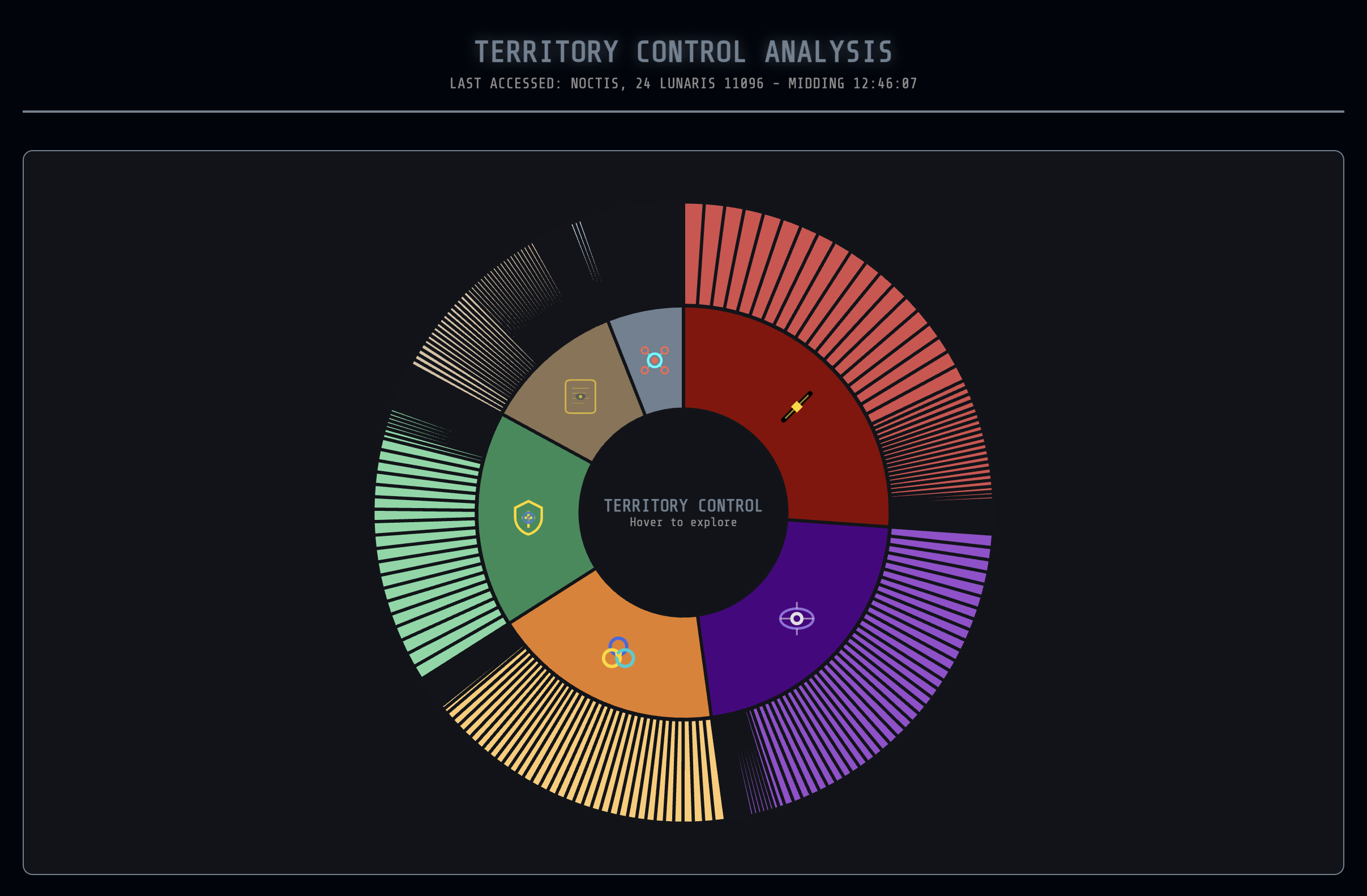
Facing strategic and operational stalemate, the sub-factions have turned to Echo Collective operatives to command their forces. Players use a specialized, secure terminal interface to manage combat opereations for their sub-faction sponsors. Operative victories or defeats shift the balance of territorial and resource control.
Player combat operations also influence sub-faction participation in the Great Sync competition.
How Combat Works
1. Receive Mission Invitation
Combat brokers identify operatives whose skills match mission requirements. You're assigned to whichever sub-faction needs your tactical expertise—the Echo Collective's neutrality prevents permanent allegiance.
Broker Tiers:
| Tier | Authority Level |
|---|---|
| Street Fixers | Entry-level skirmishes |
| Faction Liaisons | Mid-tier operations |
| Shadow Coordinators | Complex campaigns |
| War Architects | Theater-level conflicts |
| Cipher Handlers | Elite classified operations |
2. Accept Mission and Territory Assignment
When you accept a mission, you receive:
- A specific territory designation (e.g.,
reticle_combat_zone_7-2356B) - Mission type based on territory control status
- Sub-faction context explaining the strategic stakes
Territory Format: {location_id}-{zone}{suffix}
- Example:
reticle_combat_zone_7-2356B - Location ID: The combat zone identifier
- Zone Number: Numeric identifier within location
- Letter Suffix: Additional zone differentiation
Each combat zone contains numerous territories, providing extensive strategic depth.
3. Mission Types
Your mission type is determined by territory control status:
| Type | Scenario | Objective |
|---|---|---|
| Assault | Territory controlled by opponent | Capture enemy-held territory |
| Defense | Territory controlled by sponsor | Protect sponsored territory from attack |
| Expansion | Unclaimed territory | Claim neutral territory for sponsor |
4. Execute Combat Strategy Challenge
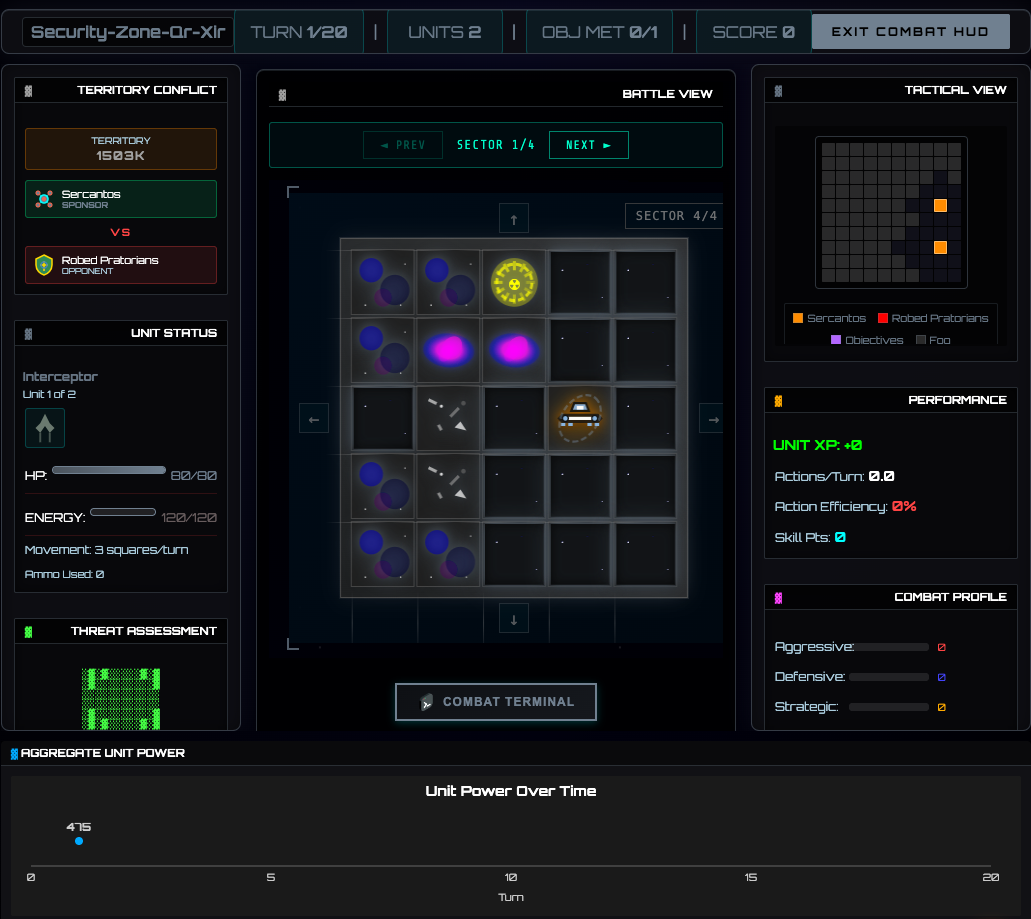
Combat missions are conducted via the Echo Terminal interface, a specialized text-based operating system designed for maximum security and robustness. The tactical combat system delivers depth comparable to strategy games like Advance Wars and Into the Breach—grid-based maneuvering, terrain effects, diverse unit types, and objective-driven missions across ground and space environments.
Operatives review forces on virtual grids and issue commands such as 'attack', 'analyze', and 'hack' to complete mission objectives.
Challenge Elements:
- Terrain Grid: Variable-size battlefield with terrain features (cover, hazards, open ground)
- Unit Positioning: Friendly and enemy forces with distinct capabilities
- Mission Objectives: Primary and advanced objectives to complete
- Control Points: Strategic positions affecting victory conditions
- Resource Management: Limited resources and power-ups to deploy
- Environmental Factors: Ground/space weather and enviornmental conditions affecting tactics
Battle Types:
- Ground Operations: Clear, rain, fog, storm, or night conditions
- Space Operations: Clear, solar flare, cosmic storm, or nebula conditions
Mission Objective Types:
- Defense: Hold position against assault
- Infiltration: Penetrate enemy defenses
- Rescue: Extract assets under hostile conditions
5. Performance Ratings
Simply completing missions isn't enough. Operatives are rated (and receive operatioal rewards) based on their performance, which is measured on a scale from
S through F based on:
- Operational efficiency: Unit survival and other factors
- Objective completion: Whether primary and secondary mission objectives were completed; completing secondary objectives boosts ratings
Operational Time Windows
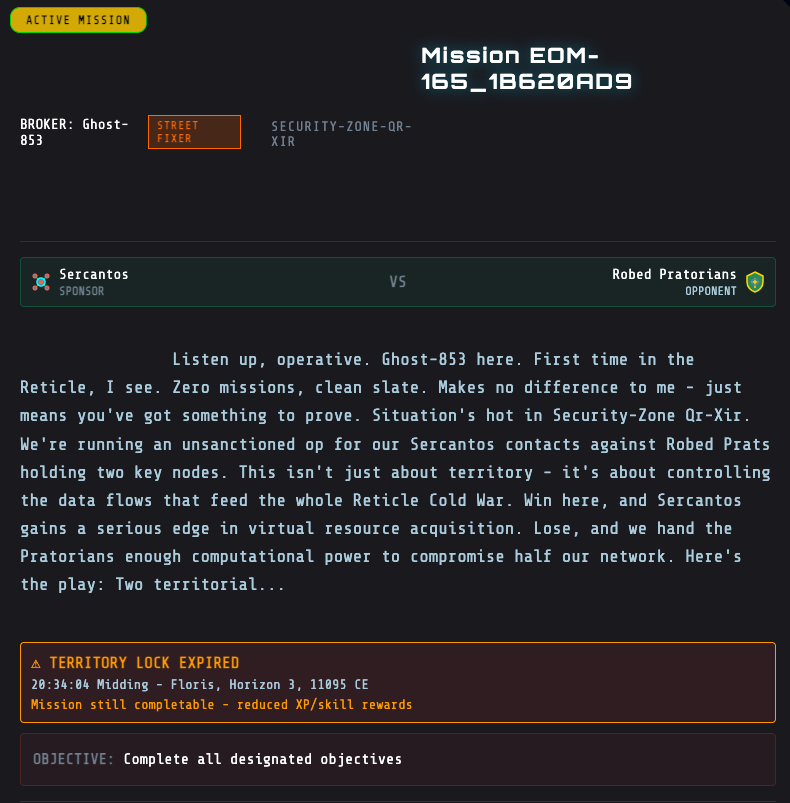
Operatives do not have unllimited time to complete missions. When an invitation is accepted a timer is activated, during this period, the mission is locked, meaning other players cannot accept or interact with the mission.
Time limits are based on mission difficulty:
| Operation Tier | Time Window |
|---|---|
| Tier 1 (Entry) | 6 hours |
| Tier 2 (Standard) | 10 hours |
| Tier 3 (Complex) | 14 hours |
| Tier 4 (Advanced) | 18 hours |
| Tier 5 (Elite) | 24 hours |
If the mission is not completed during the specified time window, the territory is unlocked for other players to complete the mission. While it is still possible to complete a mission after the time lock has expired, the player will receive significantly reduced rewards and will have no impact on territorial control.
It is possible for operatives to abandon a mission, but that will have a significant influence on their standing with combat brokers, and access to higher-tier, higher reward missions.
Territory Value and Resources
Territories aren't equal—each has strategic value tied to resource specialization:
| Resource Type | Strategic Value |
|---|---|
| Computational Cycles | Processing power for simulations and Cypher analysis |
| Data Streams | Ongoing intelligence gathering and pattern recognition |
| Network Access | Physical access to critical network infrastructure |
| Strategic Nodes | Control points for broader network influence |
| C.Script Generation | Virtual currency generation through zone taxation |
Higher-resource rich territories attract more aggressive competition and offer greater rewards.
Territory resource acqusition influences how sub-factions participate in the Great Sync competition. Sub-factions with higher amounts of resources can contribute greater power to machines, which influences their placement in the competition and the amount of Memory Fragments generated by the machine during each Great Sync cycle. Memory Fragments are used to craft certain items and are needed to feed 'Attractors,' which deliver airdrops and crafting blueprints to players.
Performance Rewards
| Rating | Efficiency | XP Multiplier |
|---|---|---|
| S | 90%+ | 130% |
| A | 75-89% | 115% |
| B | 60-74% | 100% |
| C | 45-59% | 85% |
| D | Below 45% | 70% |
| F | Mission failure | 10-15% |
Estimated Skill XP Distribution from Combat:
- Basic Combat (20%)
- Tactical Planning (20%)
- Advanced Combat (15%)
- Pattern Recognition (10%)
- Echo Interface (10%)
- Specialized Weapons (10%)
- Analytical Thinking (10%)
- Information Gathering (5%)
The Stakes
Combat operations determine real territorial control in the Reticle Cold War:
- Victory: Your sponsor gains the territory and your contribution is noted
- Defeat: The opponent gains the territory
- Abandonment: Sponsor suffers defeat, no territory changes (only applies during the period when the territory is locked)
Every territory capture records the operative who secured it. Your contributions to the Cold War accumulate over time, building your reputation with the sub-factions you've supported.
Learn More
- The Six Sub-Factions - Who's fighting and why
- Combat Strategy Challenges - In-depth challenge mechanics
- Complete Gameplay Experiences - All 20+ experiences